
Anyone in the trade who values a used electric car has to check the battery health of the electric car before a reliable purchase price can be set. The traction battery accounts for a considerable share of the vehicle’s value – and unlike with a combustion engine, the mileage reveals very little about its actual condition. For dealers, fleet operators and rental companies, the question is therefore not academic but directly relevant to decisions: how healthy is the battery, and which method delivers a reliable answer quickly? This guide compares the common methods – from the classic EV battery test to over-the-air retrieval –, explains the central SoH value and shows which method suits which situation.
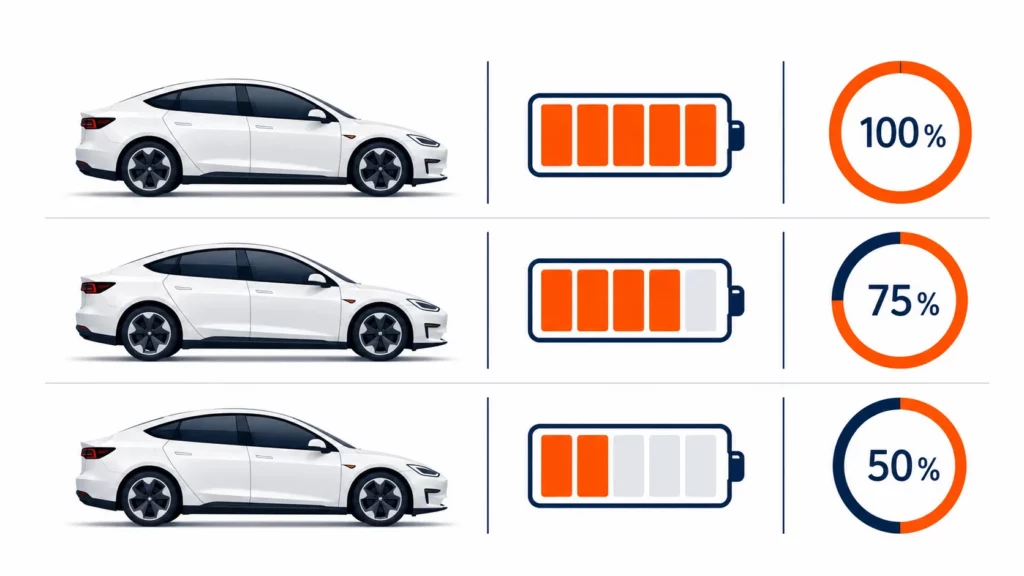
Table of contents
Checking EV battery health: the key topics
From the definition of the SoH value to retrieval via VIN: these topics explore the individual aspects of battery health checks in depth – each in its own dedicated article.

What is the SoH value?
A short definition of the State of Health.
Understanding the battery SoH value




Remaining capacity & residual value
What the value means for purchasing.
Putting remaining capacity and residual value into context
What does “battery health” mean for an electric car?
Battery health describes how much of its original storage capacity a traction battery still has today. Experts use the term State of Health (SoH) for this and express it as a percentage: a brand-new battery has an SoH of 100 percent, and this value decreases with use. How quickly it decreases depends primarily on charging behaviour: a recent analysis of real fleet data cites a capacity loss of around 1.5 to 3 percent per year, depending on charging behaviour. We explore what the SoH value means in detail and how it is technically composed in the article Understanding the battery SoH value.
Important in practice: age and mileage are only rough indicators. Two vehicles of the same model year can differ considerably in battery health – depending on how they were charged and driven.
With electric cars, mileage and year of manufacture are no longer reliable indicators of value. What matters is the measured battery health – and that cannot be derived from the vehicle’s history.
Why battery health is crucial for dealers, fleets and rental companies
In a commercial setting, battery health has a direct impact on margins. When buying, it determines the fair purchase price; when selling, a documented condition builds trust and prevents later complaints. For fleets and lease returns, it determines the realistic residual value – often for dozens of vehicles at once.
- Purchasing: a pricing basis instead of gut feeling – the SoH value replaces estimates based on age and mileage.
- Sales: proven battery health increases sales certainty and reduces the risk of complaints.
- Fleet & leasing: returned vehicles can be assessed and classified objectively based on the SoH value.
- Rental: range and condition planning across the entire fleet.
This is exactly where the weakness of many common testing methods becomes apparent: they are designed for the individual vehicle. Anyone who needs to assess an entire inventory needs a method that scales with the number of vehicles.
Which methods exist for checking battery health
Several approaches have become established for checking battery health. They differ mainly in whether the vehicle has to be physically accessible and how long the check takes per vehicle.
Physical tests with a diagnostic box and test drive
The classic approach combines reading out data via the OBD interface (the diagnostic port in the vehicle) with a load or acceleration test. A diagnostic device records parameters such as cell voltages, temperature curves and discharge curves. Providers such as testing organisations or independent service providers then issue a battery certificate stating the SoH value as a percentage.
These tests are considered precise but are time-consuming: depending on the method, they take between around 15 and 90 minutes, require physical access to the vehicle or a longer drive, and usually cost around 100 to 150 euros per vehicle. That is practical for assessing individual vehicles – but for evaluating an entire stock of vehicles, it quickly becomes a bottleneck.
Retrieving battery data over the air via VIN
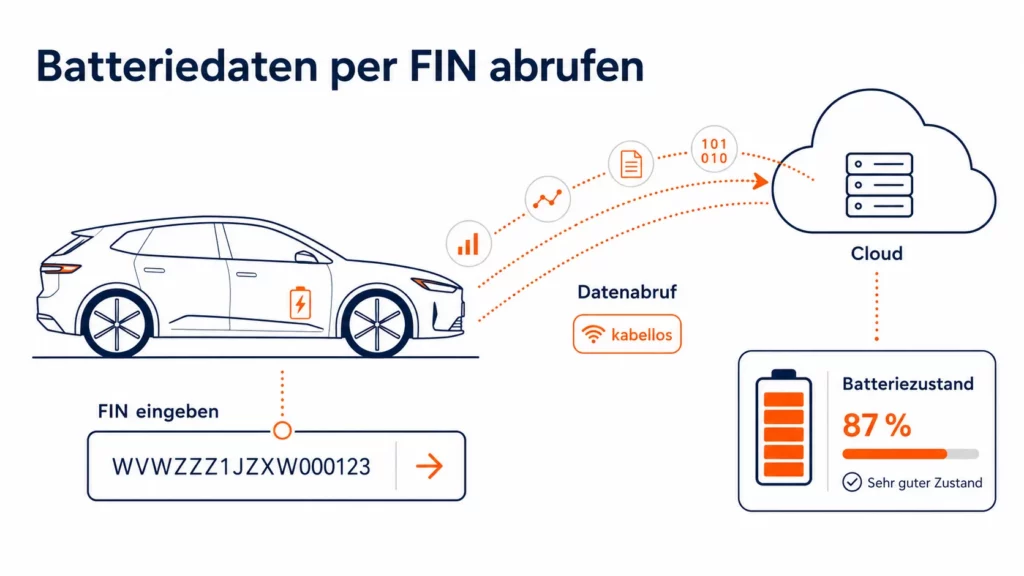
Modern electric vehicles are in constant data connection with the manufacturer anyway. This logic can be used to query battery health without connecting a device: by entering the vehicle identification number (VIN), the manufacturer’s data on the SoH value is retrieved – without a plug, without a test drive, without a workshop visit. We describe how such a query works technically in OTA battery diagnostics and in the article on battery checks via VIN.
It is precisely for this use case that autoDATAexperts has developed SoH OTA, a solution that retrieves battery health directly from the manufacturer via a VIN query. The decisive difference for the trade: the query is completed in seconds and works even when the vehicle is not on site at all – for example, when pre-assessing a purchase or an entire fleet package.
While a physical test ties up time, staff and access for each vehicle, an over-the-air retrieval via VIN can be applied to any number of vehicles – the method scales with the inventory rather than with the effort.
The following overview compares the approaches from a B2B perspective:
| Method | Vehicle access required? | Time per vehicle | Suitable for entire inventory? | Result |
|---|---|---|---|---|
| Manufacturer check (BMS) | Yes (workshop/service) | variable | Limited | SoH from the on-board system |
| Physical test (box + drive) | Yes | approx. 15–90 min | Time-consuming | Certificate with SoH in % |
| Over-the-air retrieval via VIN | No | Seconds | Yes | SoH value directly from the manufacturer |
What the SoH value means for purchasing and residual value
An SoH value only becomes useful once it can be translated into a price. As a rough guide, values above 70 percent are considered fit for practical use – many manufacturers guarantee a minimum capacity of this order. Volkswagen, for example, guarantees at least 70 percent of capacity for its ID. models after eight years or 160,000 kilometres. The higher the measured SoH, the more reliable the residual value applied – and the lower the risk of a vehicle losing value after purchase. We explore how specific values affect the remaining range in the article on the remaining capacity of EV batteries.
“The cost side also favours the digital route in the trade: a VIN query costs considerably less per vehicle than a physical individual test – and requires no appointment logistics.”
Mandatory from 2027: EU battery passport and DAT valuation
The importance of battery health will continue to grow due to regulation. From 18 February 2027, the digital EU battery passport will become mandatory for electric vehicles; this is set out in the EU Battery Regulation (EU) 2023/1542. Among other things, it is intended to make SoH data, charging history and production data transparent. At the same time, Deutsche Automobil Treuhand (DAT) has added battery condition to its vehicle valuation system, so that a determined SoH value can be factored directly into the valuation of a used car.
For the trade, this means: documented battery health is changing from a bonus to a basic requirement. Anyone who establishes processes today that allow the SoH value to be determined quickly and transparently will be prepared for the upcoming requirements instead of having to catch up later.
EV battery test: what matters in the used car trade
Anyone who has the battery of an electric car tested answers three questions that determine margin and risk: what is the vehicle worth at purchase, how secure is the sale – and how well is its condition documented?
Checking the EV battery when buying
The battery is the most expensive component of an electric car. Anyone who does not check the battery of a used electric car is calculating the purchase price on assumptions. A documented SoH value makes battery health comparable – regardless of mileage and vehicle age.
Battery check before the sale
A battery check also creates clarity when selling – towards the buyer and with regard to possible claims after handover. What dealers need to consider legally is explained in the article on warranty for electric car batteries.
Documenting battery test results
A battery test is only as valuable as its documentation. How the SoH value fits into a battery condition assessment and what a battery certificate for an electric car should contain is covered in the in-depth articles.
Conclusion
In the commercial vehicle trade, checking the battery health of an electric car is not optional – it is the basis of every sound valuation. Physical tests deliver precise results for the individual vehicle but reach their limits with larger numbers of vehicles. Over-the-air retrieval via VIN closes exactly this gap – quickly, scalably and without vehicle access. With the EU battery passport approaching, now is the right time to set up a reliable valuation process.

Trust through data transparency
“We clarify in advance how SoH data can be integrated into your purchasing and valuation processes. Via a VIN query, you receive the battery health directly from the manufacturer – no plug, no workshop visit.”
FAQ
How do you check the battery health of an electric car?
There are several methods. Physical tests read out the battery via the OBD interface and often combine this with a test or load drive; the result is a battery certificate stating the SoH value as a percentage. Alternatively, battery health can be retrieved over the air via a VIN query directly from the manufacturer’s data, without connecting any device. Which method is suitable depends on the vehicle, the time budget and the number of vehicles.
Can battery health be checked without a workshop or diagnostic box?
Yes. For supported models, the SoH value can be retrieved over the air – simply by entering the vehicle identification number (VIN). No diagnostic device, no test drive and no workshop visit are required. This is particularly interesting for dealers and fleets that need to assess many vehicles.
What does an SoH value of, for example, 90 percent mean?
An SoH of 90 percent means that the battery still has around 90 percent of its original storage capacity. Values above 70 percent are generally considered fit for practical use. The higher the value, the more reliable the vehicle’s residual value – a high SoH is therefore a strong argument in price negotiations.
Which electric cars can be checked over the air?
Currently supported are, among others, Tesla (almost all models), many models from BMW and Mazda, and numerous vehicles of the VAG Group from 09/2024 (e.g. VW ID. series, CUPRA Born and Tavascan, Skoda Enyaq and Elroq, Audi Q4 e-tron). The list is continuously being expanded, and further models will follow.
How long does an EV battery test take?
It depends on the method. Physical tests in a workshop take around 15 to 90 minutes, depending on the procedure. Retrieval via VIN, by contrast, requires neither an appointment nor a connection to the vehicle – the SoH value is available in seconds.