

Anyone working with electric vehicles in the used car trade knows the problem: the condition of the high-voltage battery determines value, remaining service life and saleability – but until now, a reliable assessment required either a workshop visit or an OBD diagnosis with a plug connected to the vehicle. Checking the SoH value via VIN is an alternative that eliminates exactly this effort: using the vehicle identification number, the battery data is retrieved directly from the manufacturer – no plug, no workshop appointment, no waiting time. This article shows how the process works, which vehicles are supported and what advantages it offers dealers, fleet managers and rental companies.
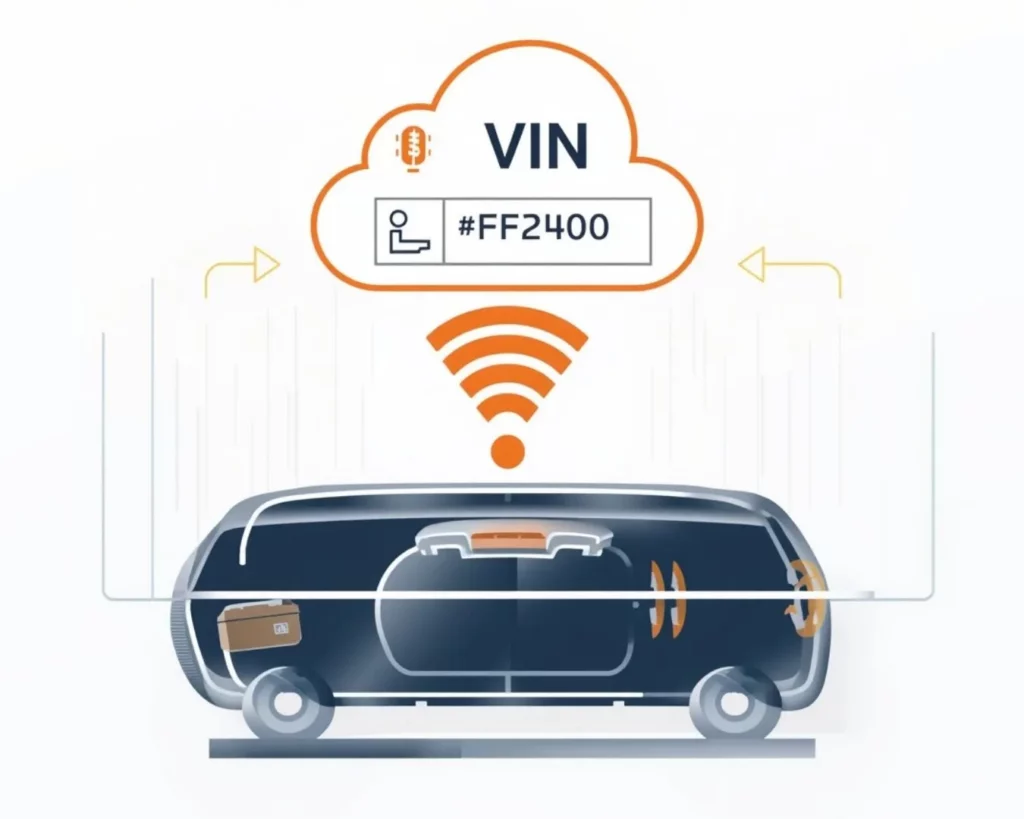
Table of contents
What does the SoH value of an EV battery mean?
The State of Health – SoH for short – describes the remaining performance of a high-voltage battery compared with its condition when new. An SoH value of 100% means that the battery delivers its full original capacity. At 85%, 85% of the original usable energy is still available. The value is therefore the most important indicator of the remaining range, residual value and life expectancy of an electric car.
With every charging cycle, through temperature stress and chemical ageing, a lithium-ion battery gradually loses capacity. How quickly this loss occurs depends on usage behaviour, charging habits and climate – two identical vehicles of the same model year can show significantly different SoH values at the same mileage. A sound battery assessment is therefore not a box-ticking exercise but the basis of any serious pricing.
You can find a detailed explanation of the SoH value in our »guide to battery SoH«
Registration, process and billing per query – we clarify the key details in a short conversation.
Checking SoH via VIN – what is behind it?
The vehicle identification number as the key to the battery history
The vehicle identification number (VIN) uniquely identifies every vehicle worldwide; in Germany it is also known as the FIN. It consists of 17 characters and is linked to the manufacturer backend: telemetry data, software versions and – crucially – battery data are stored there. Modern electric vehicles continuously transmit status data to the manufacturer cloud via their mobile network connection – the technological basis of this data transmission is »OTA updates«.
An SoH query via VIN accesses exactly this data. Instead of reading out the vehicle, the value is retrieved where it is stored anyway: with the manufacturer itself.
What data the manufacturer provides
Depending on the manufacturer, the VIN query returns a specific SoH value as a percentage. The data comes from the vehicle’s battery management system (BMS) and is validated by the manufacturer. The assessment is therefore based on the same data the manufacturer itself uses for guarantee and warranty decisions – a reliable figure.
Methods compared: OBD, workshop and VIN query
There are currently three main methods available for battery assessment. The following overview shows the operational differences:
| Criterion | OBD diagnosis | Workshop visit | VIN query (OTA) |
|---|---|---|---|
| Vehicle access required | Yes, with a plug | Yes, drop-off/pick-up | No |
| Workshop required | No | Yes | No |
| Duration per query | 10–30 minutes | Several hours to days | Seconds to minutes |
| Data source | Vehicle BMS directly | Manufacturer diagnostic device | Manufacturer backend |
| Data reliability | medium to high (device-dependent) | high | high (manufacturer-validated) |
| Scalability (fleet) | limited | low | high |
| Workshop-related costs | low | high | none |
| Use when purchasing | partly suitable | time-consuming | ready to use immediately |
The VIN query is not the right choice in every scenario – for vehicles without a mobile network connection or older models without the corresponding backend connection, OBD or workshop diagnostics remain the methods of choice. For current electric vehicles with a manufacturer cloud connection, however, it is by far the most efficient method.
Step by step: how an SoH query via VIN works
The operational process of a VIN-based SoH query is deliberately kept lean:
Requirements
- Access to a platform that provides the VIN connection to the manufacturer backends
- The 17-character VIN of the vehicle to be assessed
- A supported vehicle (see next section)
The operational process
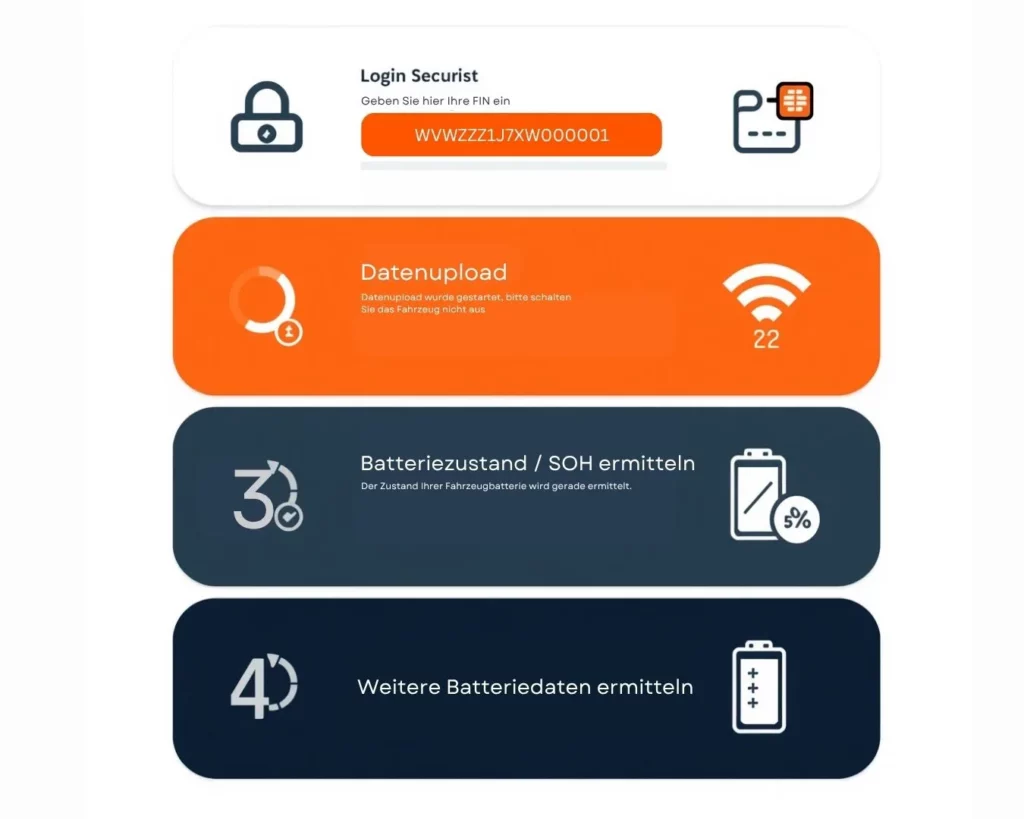
- Registration and login on the platform
- Enter the VIN – the number can be found in the vehicle registration document, on the door pillar or behind the windscreen
- Start the query – the platform forwards the request to the backend of the respective manufacturer
- Receive the result – the SoH value is displayed directly; for some manufacturers, it is supplemented by additional information such as charging cycles or capacity history
Result and interpretation
The returned SoH value is usually expressed as a percentage. Values above 90% are considered unremarkable in the first few years; values below 80% require a more differentiated assessment – especially with regard to residual value and warranty claims. There is no blanket threshold; what matters is how the value relates to age, mileage and comparable identical vehicles.
Which vehicles support the SoH query via VIN?
Not every electric vehicle is accessible for the VIN query. A prerequisite is a continuous connection between the vehicle, the manufacturer backend and the querying platform. The following manufacturers and models are currently supported:
| Manufacturer | Supported models |
|---|---|
| Tesla | almost all models |
| BMW | many models |
| Mazda | many models |
| VW (from 09/2024) | ID.3, ID.4, ID.5, ID.7, ID.7 Tourer, ID.Buzz |
| CUPRA/Seat (from 09/2024) | Born, Tavascan |
| Skoda (from 09/2024) | Elroq, Enyaq, Enyaq Coupe |
| Audi (from 09/2024) | Q4 e-tron |
The list is continuously being expanded. Manufacturers that are not listed cannot currently be queried via VIN – for these vehicles, OBD diagnosis or a workshop readout remain the options of choice.
Practical application: used car purchasing, fleets, rental cars
The VIN query delivers its operational benefit above all where many vehicles have to be assessed in a short time – i.e. precisely in the core processes of dealers, fleets and rental companies. A typical use case is the advance assessment of electric car lease returns, in which entire return cohorts are assessed via VIN before the vehicles come back.
Example dealer: risk protection in purchasing
A used car dealer receives an offer for a two-year-old electric vehicle with 45,000 km. Before purchasing, he checks the SoH value via VIN: if the value is significantly below the average of comparable vehicles, he can adjust the purchase price accordingly or withdraw from the deal. A sound assessment that previously would have required a workshop visit is completed in minutes.
It is precisely for this use case that autoDATAexperts has developed »SoH OTA«, a solution that retrieves battery health directly from the manufacturer via a VIN query. Dealers receive the value after logging in and entering the VIN on their platform – billing is monthly by invoice per vehicle queried.
Example fleet: residual value management
Fleet managers with vehicle numbers in the hundreds manage their resale strategy based on battery health. Anyone who regularly knows the SoH value of their vehicles can remove precisely those units from the fleet at the optimal time whose residual value would drop noticeably with further capacity loss. The VIN query provides the data basis here without a single vehicle having to go to the workshop.
Example rental company: vehicle rotation
Rental companies typically rotate their fleets every 6–18 months. If the SoH value is documented transparently before resale, the proceeds from the residual value buyer can be better managed – and conversely, when buying used electric vehicles, the VIN query protects against hidden defects.
Legal and regulatory context
The importance of reliable battery data will be further strengthened by regulation in the coming years. Two developments are particularly relevant:
- »UN R156« – the UN regulation on software updates and software update management systems – has been setting binding requirements for the secure transmission of vehicle data via mobile networks since 2024. It is the regulatory basis on which OTA-based methods such as the VIN query operate.
- »EU Battery Passport« – mandatory for new EV batteries in the EU from February 2027. It will make key battery metrics, including the SoH value, digitally traceable. Anyone already working with VIN-based assessment methods today is prepared for the upcoming requirements.
Both developments are turning battery data from »nice-to-have« information into an integral part of purchasing, valuation and warranty processes.
Conclusion
The SoH query via VIN is not a niche method but the operational consequence of increasingly connected vehicles, growing EV fleets and rising demands for data transparency. For dealers, fleets and rental companies, it replaces the workshop visit with a login and delivers data directly from the manufacturer backend – reliable, fast and scalable. Anyone who integrates this process into their purchasing and valuation routines gains valuation certainty and speed where the two have so far been at odds with each other.
We will be happy to discuss in a personal conversation how a VIN-based SoH query can be integrated into your purchasing and valuation processes.
OverTheAir by autoDATAexperts
The battery health comes to you.
Not the other way around.
Enter the VIN, receive the SoH report – without the vehicle on site. €29 per query, no subscription.
Register for freeFAQ
What is an SoH query via VIN?
An SoH query via VIN is a method in which the State of Health value of an electric car battery is retrieved directly from the manufacturer’s backend using the vehicle identification number. No workshop visit and no OBD plug on the vehicle are required. The returned value is based on the vehicle’s telemetry data and is considered a reliable basis for valuation and purchasing decisions.
Which vehicles support the SoH query via VIN?
Currently supported are Tesla (almost all models), BMW and Mazda (many models) and selected VAG models with a production date from 09/2024: VW ID.3, ID.4, ID.5, ID.7, ID.7 Tourer, ID.Buzz, CUPRA/Seat Born and Tavascan, Skoda Elroq, Enyaq, Enyaq Coupe and Audi Q4 e-tron. Further manufacturers and models are continuously being added.
How reliable is SoH data from a VIN query?
The data comes from the vehicle’s battery management system and is validated by the manufacturer itself. The assessment is therefore based on the same data the manufacturer uses for guarantee and warranty decisions. As a result, its reliability is generally higher than that of generic OBD readouts with third-party devices.
What are the advantages of the VIN query over an OBD diagnosis?
The VIN query requires no physical access to the vehicle, no plug and no workshop. It is completed within seconds to minutes and scales easily to large vehicle fleets. It also accesses validated manufacturer data, whereas the data quality of OBD diagnoses can vary depending on the device. For current electric vehicles with a manufacturer cloud connection, the VIN query is therefore the most efficient method.