

A customer buys a used electric car, drives through the first winter and gets in touch: the range is much lower than expected, and he wants to withdraw from the purchase. For dealers, this is the core question of the electric car battery warranty: is declining battery capacity a material defect – and who has to prove what in a dispute? A recent ruling by the Higher Regional Court (OLG) of Celle in Germany brings more clarity here. But it also shows where such cases are decided: on the documented battery condition at the time of handover. This article puts the legal situation into context for car dealerships and used car dealers and shows how you can document the handover in a traceable way.
Key points at a glance
- According to a recent ruling by the OLG Celle, age-related capacity loss is not a material defect as long as it corresponds to the state of the art.
- If a defect appears within 12 months of handover in a sale to a consumer, it is presumed to have existed at handover – in case of doubt, the dealer must then prove otherwise.
- A dated SoH value from the day of handover is the most important evidence for this; clear contracts and careful range information complement it.
Note: This article is for general information only and does not replace legal advice. For drafting your purchase contracts and in a specific dispute, please consult a lawyer. Legal status (German law): October 2026.
Table of contents
Electric car battery warranty: what dealers owe
There are no special rules for the traction battery. It is part of the vehicle and is therefore subject to statutory liability for material defects – colloquially, the warranty. What matters is the condition at the time of handover, legally the transfer of risk. If there is a material defect at that point, the buyer can assert the rights under § 437 of the German Civil Code (BGB): first subsequent performance, and under further conditions withdrawal, price reduction or damages.
As with all movable goods, the claims become time-barred 2 years after delivery (§ 438 (1) no. 3, (2) BGB). If a dealer sells a used car to a consumer, he may shorten this period to 1 year – but only under two conditions, both of which must be met (§ 476 (2) BGB):
- The buyer was informed of the shortening specifically before making his contractual declaration.
- The shortening was agreed in the contract expressly and separately.
A clause that merely appears in the general terms and conditions does not meet these requirements according to the wording of the law. A complete exclusion of the warranty is invalid towards consumers (§ 476 (1) BGB).
Statutory warranty, manufacturer’s guarantee, dealer guarantee – three different things
These terms are often mixed up in sales conversations. For the dealer’s liability, however, the distinction is crucial:
| Statutory warranty | Manufacturer’s battery guarantee | Voluntary dealer guarantee | |
|---|---|---|---|
| Basis | Law (§§ 434 et seq. BGB) | Manufacturer’s guarantee terms | Dealer’s guarantee declaration (§ 443 BGB) |
| Who is liable? | Seller | Manufacturer | Dealer or guarantor |
| What is covered? | Defects present at handover | Falling below a promised residual capacity within the term | What the guarantee terms specify |
| Typical scope | 2 years; for used cars sold to consumers, can be shortened to 1 year | Often cited: at least 70 % battery health (State of Health, SoH) within 8 years or 160,000 km (example according to DAT) | Freely definable |
The manufacturer’s guarantee complements the dealer’s warranty but does not replace it. Whether and under what conditions it passes to subsequent owners is governed by the respective guarantee terms – you should check these for each vehicle.
The manufacturer’s battery guarantee does not replace the dealer’s statutory warranty. Both exist side by side – with different requirements and different parties liable.
For leased vehicles, incidentally, the question of battery risk arises elsewhere: there, the leasing contract governs who bears a loss in value. More on this in the article on electric car lease returns.
Is capacity loss a material defect? What the OLG Celle decided
The Higher Regional Court of Celle dealt with exactly this question (ruling of 2 July 2026, ref. 7 U 85/24). A buyer had purchased a used small electric car from an authorised dealer and later complained of a significantly lower range than stated by the manufacturer. She wanted to withdraw from the purchase contract. The court found no material defect (report in kfz-betrieb).
The reasoning contains three points that are relevant for dealers:
- State of the art as the benchmark: A vehicle that corresponds to the state of the art of comparable vehicles is not defective merely because this state falls short of the buyer’s expectations. Accordingly, age-related capacity loss to the usual extent is not a defect within the meaning of § 434 (3) BGB.
- Cross-manufacturer comparison: The court does not measure what is “usual” only against the same model, but against comparable vehicles from different manufacturers – series defects are disregarded.
- Strict requirements for commitments: The court only assumes a binding agreement on range in clear cases. An alleged verbal range commitment could not be proven in the proceedings.
It is revealing what the court based its argument on: the SoH value. According to the expert report, the battery condition of the vehicle, which was around 4.5 years old, was 93.5 % – a loss just below average. Based on a winter range of 235 km for comparable new vehicles, this suggested a range of around 220 km, which the vehicle also achieved on a test drive at around 0 °C (ruling report at Otto Schmidt, source: Justiz Niedersachsen). The SoH was thus the benchmark for deciding whether the range is “normal”.
The ruling is not a carte blanche. It is a decision by a higher regional court in an individual case. And the law names constellations in which capacity loss can indeed be a defect: if the battery is significantly below what is usual for comparable age and comparable use; if a specific range or capacity was contractually agreed; or if public statements – for example in advertising or a listing – have raised legitimate expectations (§ 434 (3) sentence 1 no. 2 BGB). Range information in listings and in sales conversations therefore deserves particular care. How SoH values can be classified technically is shown in the article on valuing the remaining capacity of electric car batteries.
A first-instance ruling by the Regional Court (LG) of Wuppertal shows that such cases can also turn out differently (18 Dec 2025, ref. 10 O 282/23): according to an expert report on the chassis dynamometer, an electric car bought new only achieved 282 km instead of the stated WLTP range of 332 to 341 km. The court applied the case law of the Federal Court of Justice (BGH) on excess fuel consumption in combustion vehicles, according to which deviations of 10 % or more are significant, to the range and allowed the withdrawal. The difference to Celle: there, it was about the normal ageing of a used car; here, about a significant deviation from the manufacturer’s specification for a new vehicle.
Reversal of the burden of proof: why the SoH at handover is decisive
If a dealer sells to a consumer, a statutory presumption helps the buyer in the first 12 months (§ 477 (1) BGB). However, it only concerns the question of when a defect arose – not whether one exists at all. The buyer must first show a non-conforming condition. Normal, age-appropriate ageing as in the OLG Celle case is not such a condition; the presumption then does not apply at all.
If, on the other hand, a non-conforming condition appears within 12 months – for example an SoH significantly below what is usual for age and mileage – the dealer must, in case of doubt, prove that it did not yet exist at handover. This reversal of the burden of proof only does not apply if it is “incompatible with the nature of the goods or the nature of the lack of conformity”. Whether this exception applies to the ageing of a battery cannot be answered across the board.
After the 12 months have expired, the burden of proof lies with the buyer again: he must then prove that the defect already existed at handover. If you have effectively shortened the limitation period to 1 year, the presumption and the limitation period expire largely at the same time. A special rule applies to consumers: if a defect appears within the limitation period, the limitation period does not end before 4 months after it first appeared (§ 475e (3) BGB). A defect that appears shortly before the end of the period can therefore still be asserted after 12 months.
In practice, this means: the most reliable evidence is a measured value from the day of handover. It is the fixed starting point against which later changes can be measured. Without it, the condition at handover can only be reconstructed approximately in a dispute.
For this step, autoDATAexperts has developed a method with SoH OTA that retrieves the battery condition via VIN query directly from the vehicle manufacturer’s data – without a plug and without a workshop appointment. The value can be included with the date in the handover documentation. Currently supported are many models from Tesla, BMW and Mazda as well as selected electric models from the Volkswagen Group; further manufacturers and models are being added continuously. Details on the process can be found in the article Check SoH via VIN. How much weight a measured value carries in a dispute is assessed by the court and experts in each individual case.
If a defect appears in the first 12 months after handover, it is presumed to have existed at the time of sale. A dated SoH value from the day of handover is the starting point against which later changes can be measured.
Consumer or business customer: what changes
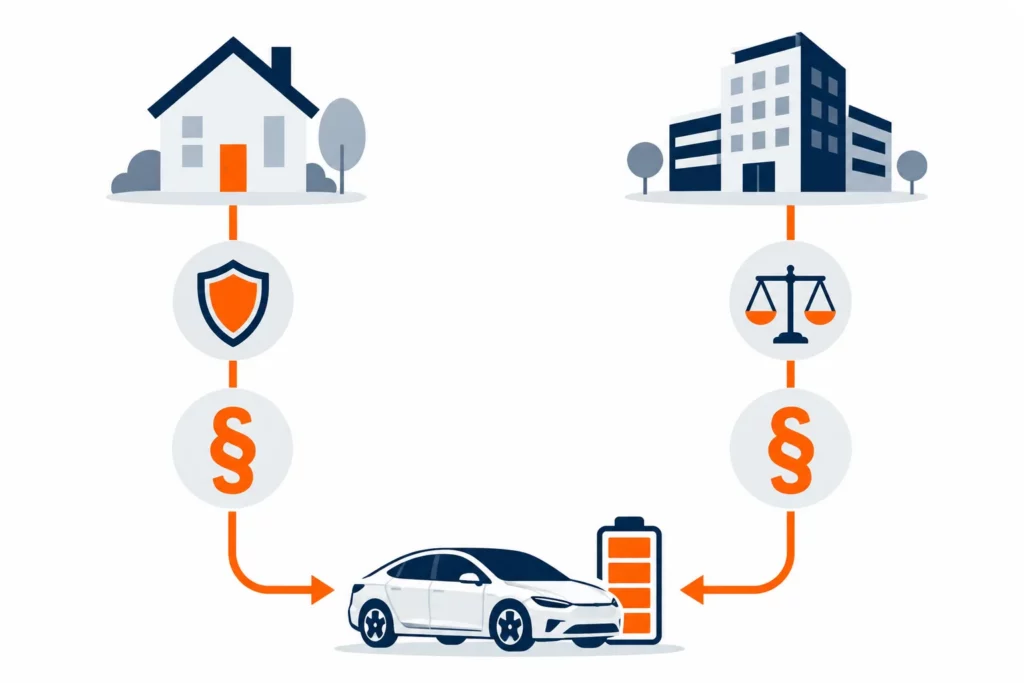
Not every buyer is a consumer. Fleets, rental companies and fellow dealers usually buy as entrepreneurs. The purpose of the purchase is decisive (§ 13 and § 14 BGB). The protective provisions on the sale of consumer goods only apply when a consumer buys from an entrepreneur (§ 474 BGB).
| Sale to consumers | Sale to businesses (e.g. fleet, rental company, dealer) | |
|---|---|---|
| Legal framework | Sale of consumer goods with protective provisions (§§ 474 et seq. BGB) | General sales law; for mutual commercial sales also the German Commercial Code (HGB) |
| Exclusion of warranty | Invalid (§ 476 (1) BGB) | Generally definable by contract; limits include fraudulent intent or an assumed guarantee (§ 444 BGB) and general terms and conditions (§§ 307 et seq. BGB) |
| Shortening of the limitation period | For used cars to 1 year, only with a separate notice and a separate agreement (§ 476 (2) BGB) | Definable by contract, observe statutory limits |
| Reversal of the burden of proof | Yes, 12 months from the transfer of risk (§ 477 BGB) | No – the buyer must prove the defect |
| Duty to inspect and give notice of defects | None | For mutual commercial sales: inspect the goods without delay and report defects without delay (§ 377 HGB) |
For sales to business customers, this means more room for manoeuvre, but also its own pitfalls. Have your contractual terms legally reviewed for both customer groups – in particular clauses on the limitation of liability.
Checklist: documenting the handover of a used electric car
The following points summarise what can be derived from the law and case law for practice:
- Record the SoH value: Include the value with date, mileage and source of the measurement in the handover protocol or purchase contract.
- Document the manufacturer’s guarantee: Record the remaining term and conditions of the battery guarantee and hand them over to the buyer.
- State the range properly: Only give range values with a reference (e.g. “standard range of the new vehicle according to the manufacturer”) and make no verbal range commitments.
- Do not conceal known weaknesses: Anyone who fraudulently conceals a defect known to them can rely neither on an exclusion nor on a limitation of liability (§ 444 BGB); in addition, the regular limitation period then applies instead of the one under sales law (§ 438 (3) BGB).
- Disclose deviations: If the SoH is below what is usual for age and mileage, specifically inform the buyer of this before concluding the contract and agree on the deviation expressly and separately in the contract (§ 476 (1) sentence 2 BGB).
- Shorten the period in the correct form: When shortening to 1 year, give a separate notice before concluding the contract and make a separate agreement (§ 476 (2) BGB).
- Clarify the customer group: For business customers, document their status as entrepreneurs and have the contractual terms legally reviewed.
How battery proof can also be used in the sales process is described in the article on the battery certificate for electric cars. You can find the basics of the SoH value itself in the article Understanding battery SoH.
Conclusion
The warranty for the electric car battery follows general sales law – with noticeable consequences for dealers. According to the OLG Celle ruling, age-related capacity loss within the state of the art is not a material defect. Towards consumers, however, the reversal of the burden of proof applies in the first 12 months as soon as a defect appears. Those who document the battery condition on the day of handover, word range information carefully and disclose deviations create a traceable basis in the event of a complaint. We would be happy to discuss in a personal conversation how an SoH query can be integrated into your handover processes.

Trust through data transparency
“We clarify in advance how SoH data can be integrated into your purchasing and valuation processes. Via a VIN query, you receive the battery health directly from the manufacturer – no plug, no workshop visit.”
FAQ
Is declining battery capacity in a used electric car a material defect?
Not automatically. According to a ruling by the OLG Celle of 2 July 2026 (ref. 7 U 85/24), age-related capacity loss is not a material defect if it corresponds to the state of the art of comparable vehicles. It may be different if the capacity is significantly below the usual level, a specific range was agreed or advertising statements raised legitimate expectations. The individual case is always decisive.
How long is a dealer liable for the battery of a used electric car?
The warranty is generally 2 years from delivery (§ 438 BGB). When selling a used car to a consumer, it can be shortened to 1 year if the buyer was specifically informed before concluding the contract and the shortening is expressly and separately agreed in the contract (§ 476 (2) BGB). If a defect appears within the period, the claim against consumers does not become time-barred before 4 months after it first appeared (§ 475e (3) BGB). A manufacturer’s battery guarantee exists independently of this under its own terms.
What does the reversal of the burden of proof mean when selling a used electric car?
The reversal of the burden of proof applies to sales to consumers. If a non-conforming condition appears within 12 months of handover, it is presumed to have existed at handover (§ 477 BGB); in case of doubt, the dealer must then prove otherwise. Normal, age-appropriate ageing of the battery is not such a condition. After the 12 months, the buyer must prove that the defect already existed at handover. The presumption does not apply to business customers.
Does the warranty also apply to sales to business customers?
Yes, but the consumer protection provisions do not apply. Limitations of liability can generally be agreed by contract with entrepreneurs, but are subject to statutory limits, for example in the case of fraudulent intent or an assumed guarantee (§ 444 BGB) and general terms and conditions. In mutual commercial sales, the buyer must also inspect the goods without delay and report defects without delay (§ 377 HGB). The specific contract design should be legally reviewed.