

When buying a used electric car, a single value often decides between profit and miscalculation: the remaining capacity of the electric car battery. It shows how much of the original storage capacity is left – and thus directly influences range, resale value and purchase price. For dealerships and fleet managers, it is therefore not a technical footnote but the central valuation metric. This article shows what the remaining capacity means economically, which values are still acceptable when buying and how to determine it reliably – without guesswork and without time-consuming workshop appointments.

Table of contents
What does the remaining capacity of an electric car battery mean?
Every traction battery loses part of its storage capacity over the years. The remaining capacity describes how much of the original capacity available ex works can still be used today – stated as a percentage. A battery with 90 % remaining capacity can therefore still store nine tenths of the energy it could hold when new.
Technically, this value largely corresponds to the State of Health (SoH), i.e. the health of the battery. The gradual loss over time is called degradation and depends on factors such as charging cycles, charging and driving behaviour and temperature. A modern battery management system (BMS) slows this ageing, but cannot stop it.
For the vehicle trade, it is important to distinguish between two terms: the gross capacity is the theoretically installed amount of energy, the usable capacity is the part actually released. The remaining capacity always refers to the usable share – this is the value that counts for range and valuation.
For a used electric car, the remaining capacity is what mileage and condition together are for a combustion car: the most important single indicator of the remaining value.
Why the remaining capacity determines the value
Remaining capacity, residual value and purchase price
For combustion cars, buyers have reliably estimated the value for decades using mileage, service book and visual inspection. For electric cars, this grid only partially applies: two vehicles of the same age and mileage can have significantly different remaining capacities – depending on how they were charged and used. Anyone who only looks at the odometer here is calculating blind.
The remaining capacity closes this gap. It makes the most important value driver of an EV measurable and therefore negotiable. A high remaining capacity justifies a higher purchase price and can be used as an argument when reselling. A low one signals a range and value risk that belongs in the calculation.
Warranty limits as a guide
The manufacturers themselves provide a reliable reference point. Many manufacturers – including BMW, Tesla and VW – grant an eight-year warranty on the traction battery and guarantee a remaining capacity of around 70 % within this framework (source: manufacturers’ warranty conditions). Typical limits are around 70 % remaining capacity within eight years or 160,000 kilometres.
Important in practice: a battery below this threshold is not “broken”. Analyses from the used car market show that many batteries still maintain high values after years, while individual early model generations are significantly lower. The range between models, years of manufacture and usage profiles is therefore large. That is exactly why an individual valuation per vehicle is worthwhile instead of a blanket assumption.
What remaining capacity is still good when buying?
The following table is intended as a guide for valuation practice – not as a rigid standard. It links the measured value with a recommended action for dealers and fleets. The 70 % mark is based on the warranty limits mentioned above.
| Remaining capacity (SoH) | Classification | Recommendation for purchase & valuation |
|---|---|---|
| ≥ 90 % | Almost as new | Full value, no capacity deduction |
| 85–89 % | Solid, normal ageing | Standard market value |
| 80–84 % | Noticeable ageing | Slight deduction, allow for reduced range |
| 70–79 % | Significant capacity loss | Apply a deduction, check remaining warranty and model history |
| < 70 % | Below typical warranty limit | High value risk, significant deduction or pass |
Before buying a used electric car, you should check these four points specifically:
- Current remaining capacity or SoH value of the specific vehicle
- Remaining manufacturer warranty on the traction battery
- Ratio of mileage and age to the measured remaining capacity
- Model-specific anomalies in the ageing process
How can the remaining capacity be determined reliably?
A look at the on-board menu is not enough for a serious valuation – the range displayed there fluctuates with temperature and driving profile and is not a reliable capacity value. Two basic approaches have become established in the trade.
Physical test vs. OTA query via VIN
| Criterion | Physical / dynamic test | OTA query via VIN |
|---|---|---|
| Intervention on the vehicle | Plug, test drive or workshop appointment required | None – only the VIN is needed |
| Time & effort | Minutes to hours plus logistics | A few seconds, regardless of location |
| Data source | Own measurement and algorithm | Battery health provided by the manufacturer |
| Vehicle must be present | Yes, physically on site | No, VIN is sufficient |
| Suitability for volume / fleets | Limited scalability | Highly scalable |
Both methods have their justification. Physical and dynamic tests provide an independent measurement and make sense where a manufacturer-independent second opinion is required. Their disadvantage in everyday trading is the effort: the vehicle must be present and an appointment organised – feasible for a single purchase, but quickly a bottleneck for larger stocks or fleets.
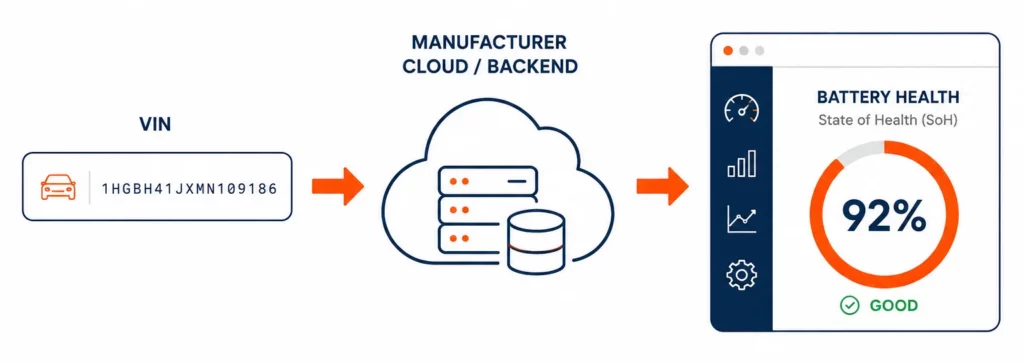
This is exactly where autoDATAexperts comes in with SoH OTA: via a VIN query, the battery health provided by the vehicle manufacturer is retrieved directly – without a plug, without a workshop visit. This makes the method particularly strong where speed and volume matter, for example when valuing entire purchase lists or fleet returns. Currently supported are, among others, almost all Tesla models, many models from BMW and Mazda and numerous vehicles of the VAG group from production date 09/2024 – including VW ID.3, ID.4, ID.5, ID.7, ID.7 Tourer and ID. Buzz, CUPRA and Seat Born as well as Tavascan, Skoda Elroq, Enyaq and Enyaq Coupé as well as the Audi Q4 e-tron. The list of supported manufacturers and models is continuously being expanded.
For valuation in the trade, it is not only whether a value is determined that counts, but how quickly and how scalably – with ten vehicles a week, the effort per query determines profitability. And the value counts a second time when selling: a dated SoH value from the day of handover is the basis if a buyer later complains about the battery capacity – more on this in the article on electric car battery warranty.
Conclusion
The remaining capacity is the most important single value driver of a used electric car – it determines range, residual value and therefore the fair purchase price. Anyone who knows it for each vehicle calculates with certainty instead of estimating and can prove the value when selling. Our process guide shows how battery health decides on take-back and marketing channel for electric car lease returns. What matters is a determination method that fits your own volume: with many vehicles, speed and scalability count. We are happy to clarify in a direct conversation how an SoH query fits specifically into your purchasing and valuation processes.
OverTheAir by autoDATAexperts
The battery health comes to you.
Not the other way around.
Enter the VIN, receive the SoH report – without the vehicle on site. €29 per query, no subscription.
Register for freeFAQ
What does the remaining capacity of an electric car battery mean?
The remaining capacity indicates how much of the originally usable battery capacity is still available today – stated as a percentage. It largely corresponds to the State of Health (SoH). A battery with 85 % remaining capacity can therefore still store 85 % of the energy of a comparable new car. The value is the most important indicator of the range and resale value of a used EV.
How much remaining capacity is still acceptable in a used EV?
As a rough guide: values from 90 % are almost as new, between 80 and 90 % normal for used vehicles. Below around 70 %, the battery is below the typical manufacturer warranty limit, which means a value risk. Which value is “good”, however, depends on age, mileage and model – an individual valuation per vehicle is therefore more meaningful than a blanket limit.
How can the remaining capacity of a battery be determined reliably?
The range display in the vehicle is unsuitable for this, as it fluctuates considerably. There are two reliable ways: a physical or dynamic test with measurement on the vehicle, or a query of the battery health provided by the manufacturer via the vehicle identification number (VIN). The VIN query works without a plug or workshop visit and is particularly suitable for valuing larger numbers of vehicles.
Does the remaining capacity affect the residual value of an electric car?
Yes, significantly. The remaining capacity is the central value driver of a used electric car because it directly determines range and usability. A high remaining capacity supports a higher purchase and selling price, a low one should be factored into the calculation with a deduction. It makes the vehicle value calculable and negotiable for dealers and fleets.