

With electric car lease returns, the battery decides how quickly and at what price the vehicle finds a second user. In 2026, a wave of young used EVs is coming back from leasing contracts – significantly more vehicles than the trade has been used to. At the same time, buyers are hesitant: according to a 2026 DAT survey, uncertainty about battery condition is one of the biggest hurdles when buying used electric cars. For fleet managers, leasing companies and remarketing managers, this means: those who know the battery risk, record the State of Health (SoH) at the right time and assess their stock in a structured way shorten days in stock and negotiate on a data basis. This guide shows how this works in practice.
The 2026 wave of returns: why the battery becomes the bottleneck for lease returns
The number of young used electric cars has risen sharply in a short time: according to the firmenauto analysis of the VMF/Deloitte study 2026, the stock of used EVs up to five years old grew from around 334,000 (2023) to around 722,000 vehicles (2025) – a doubling within two years, driven mainly by returns from leasing and fleet contracts.
This has two consequences for the remarketing process. First, the growing supply meets restrained demand: in the survey of 2,500 car buyers conducted by DAT in 2026, 65 percent see risks in the battery and 72 percent doubt the resale value of an electric car. Second, classic return protocols focus on visible damage – paint, rims, interior. The condition of the most expensive component, the traction battery, on the other hand, is often documented late or not at all. First, the growing supply meets restrained demand: in the survey of 2,500 car buyers conducted by DAT in 2026, 65 percent see risks in the battery and 72 percent doubt the resale value of an electric car. Second, classic return protocols focus on visible damage – paint, rims, interior. The condition of the most expensive component, the traction battery, on the other hand, is often documented late or not at all.
This is exactly where the study comes in: it recommends standardised battery certificates to build trust in the used car market.
The VMF/Deloitte study 2026 sees State of Health certificates as a new standard of trust for remarketing young used EVs – without reliable battery proof, the residual value lever remains unused.
Who bears the battery risk – it depends on the contract
Before talking about measurement and remarketing, it is worth looking at the leasing contract. Who bears the economic risk of an aged battery is not a technical but a contractual question. Two models dominate the fleet business. Note: the following description does not replace legal advice in individual cases. Note: the following description does not replace legal advice in individual cases.
Mileage leasing: the risk lies with the lessor
With mileage leasing, the lessee owes the return in a condition that corresponds to use in accordance with the contract. Normal signs of wear – including age-appropriate degradation of the traction battery – are at the expense of the lessor; this follows the legal principle of the German Civil Code (§ 538 BGB), according to which changes caused by contractual use are not the lessee’s responsibility. Disputes arise where excessive wear is alleged – for example with a conspicuously low SoH despite low mileage. Without a documented battery condition, this line can hardly be drawn cleanly.
Residual value leasing: the lessee bears the difference
With residual value leasing, a calculated residual value is set at the start of the contract. If the vehicle achieves less when remarketed, the lessee bears the difference. For fleets with electric vehicles, this means: every percentage point the market deducts because of an unclear battery condition goes straight onto their own balance sheet. Those who know the SoH early and can prove it negotiate the remarketing from a much stronger position.
The return in four steps: where the SoH belongs in the protocol
Hardly any guide answers the question of when the battery condition should be recorded in the return process. The answer: as early as possible – ideally before the vehicle is even collected.
| Step | What happens | Role of the battery condition |
|---|---|---|
| 1. Pre-assessment (4–8 weeks before return) | Review vehicle data, plan remarketing | Query SoH via VIN – basis for channel decision and residual value forecast |
| 2. Return appointment | Visual inspection, return protocol | Record SoH value in the protocol – prevent disputes about excessive wear |
| 3. Reconditioning & documentation | Recondition vehicle, compile documents | Add the battery report to the sales documents |
| 4. Remarketing | Choose channel, set price | Actively communicate the SoH as a selling point |
The difference between step 1 and step 2 is economically decisive: those who only measure the SoH at the return appointment or afterwards can no longer use it for planning.
Those who only measure the SoH after collection decide on the remarketing channel too late – the course for residual value and days in stock is set before the return.
Assessing the battery condition of lease returns – individually or across the stock
There are two basic ways to assess the battery of an electric car lease return – they differ mainly in whether the vehicle has to be physically available.
Testing at the vehicle
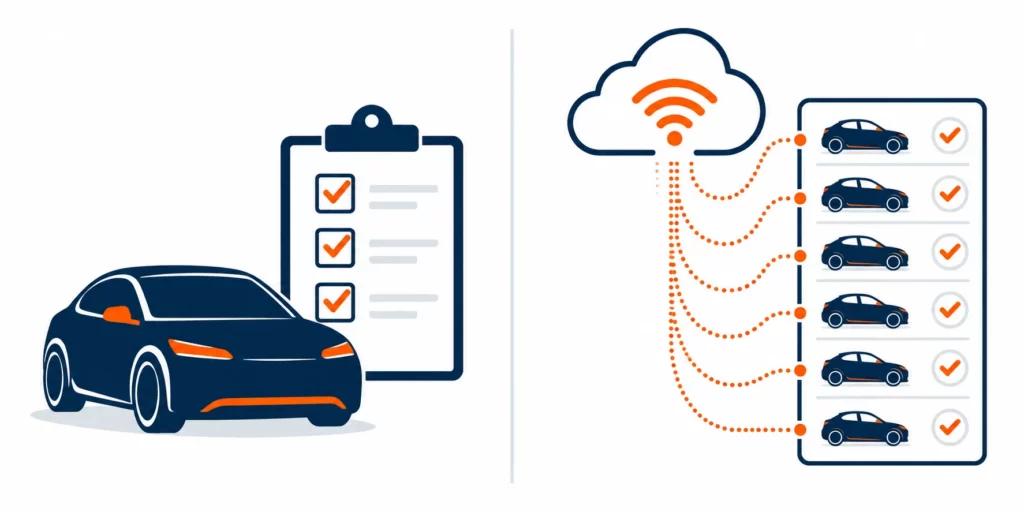
On-site testing – via the diagnostic port or a test drive by a neutral testing organisation – delivers reliable values but requires the vehicle to be accessible already: at the location, with an appointment, with staff effort. This makes sense for a single disputed case. For the pre-assessment of entire return cohorts, this approach does not scale: 50 vehicles at five locations mean 50 appointments.
Pre-assessing the returning stock via VIN
The alternative starts with the data the vehicle transmits to the manufacturer anyway. For exactly this use case, autoDATAexperts has developed a solution with SoH OTA that retrieves the battery condition directly from the manufacturer via VIN query – no plug, no workshop appointment, without moving the vehicle. For fleets and leasing companies, this means: an entire returning stock can be assessed weeks before the return, at calculable costs of €29 per query on a monthly invoice. Currently supported are Tesla (almost all models), many BMW and Mazda models and the VAG Group from 09/2024 – including VW ID.3 to ID.Buzz, CUPRA Born and Tavascan, Skoda Enyaq and Elroq, and the Audi Q4 e-tron. Further manufacturers and models are being added continuously.
From battery condition to the right remarketing channel
The documented SoH is not an end in itself – it determines through which channel a lease return can be remarketed most economically. We have broken down how the SoH value specifically affects residual value and purchase price in our article on the valuation of the electric car battery and its residual capacity. Here, the focus is on the channel decision:
| Remarketing channel | Typical use | Role of battery documentation |
|---|---|---|
| Direct sale / own dealership | Vehicles in good condition, retail business | SoH report as an active selling point – addresses the biggest buyer concern |
| B2B auction / dealer exchange | Fast remarketing of larger volumes | Documented SoH reduces bidders’ risk discounts |
| Second lease / internal continued use | Vehicles with solid SoH, extended holding period | The SoH decides whether a second term is economically calculable |
| Export / special remarketing | Vehicles with conspicuous battery condition | Transparency avoids rescissions and complaints |
The following approach has proven itself for preparing an entire cohort of returns:
- Pull the return dates for the next three to six months from the fleet management system
- Create a VIN list of the vehicles concerned
- Record the SoH per vehicle in advance and provide for it in the return protocol
- Cluster vehicles by battery condition (direct sale / auction / second lease / special remarketing)
- Include the battery report in the sales documents of each vehicle
Outlook: battery passport from 2027
From 18 February 2027, the EU Battery Regulation (EU) 2023/1542 requires a digital battery passport for newly placed electric vehicles. It does not apply retroactively to today’s returning stock – the transparency gap for vehicles built up to 2026 therefore remains and must be closed with your own proof. What reliable battery proof should contain is shown in our article on the battery certificate for electric cars; the methodological basics are explained in the battery condition assessment for electric vehicles. What to consider in terms of liability when reselling a lease return to consumers is described in the article on electric car battery warranty.
Conclusion
Electric lease returns are no longer a side issue in 2026 but core business in remarketing. Three levers determine the result: knowing the battery risk in the contract, recording the SoH before the return and choosing the remarketing channel based on data. We would be happy to show you in a personal conversation how these steps can be integrated into existing return and valuation processes.
OverTheAir by autoDATAexperts
The battery health comes to you.
Not the other way around.
Enter the VIN, receive the SoH report – without the vehicle on site. €29 per query, no subscription.
Register for freeFAQ
Who bears the battery risk with a leased electric car?
It depends on the contract model. With mileage leasing, the lessor bears the risk of normal battery ageing, as age-appropriate degradation counts as use in accordance with the contract. With residual value leasing, the lessee bears the difference if the vehicle achieves less than calculated when remarketed – an unclear battery condition then goes directly at their expense. It becomes contentious when excessive wear is alleged; only a documented SoH value helps here.
When should the battery condition of a lease return be measured?
Ideally four to eight weeks before the return date, not only at collection. Only then does the SoH value feed into the residual value forecast and the choice of remarketing channel. In addition, the value should be recorded in the return protocol on the day of return to prevent discussions about excessive wear.
How can the battery condition of an entire returning stock be checked?
For larger stocks, the query via VIN is the scalable way: the State of Health is retrieved over the air directly from the manufacturer data without the vehicles having to be inspected on site. This also allows distributed fleets at several locations to be assessed uniformly before the return. Testing at the vehicle remains useful for individual disputed cases.
Does the EU battery passport also apply to today’s lease returns?
No. The digital battery passport is only mandatory from 18 February 2027 for newly placed electric vehicles. Vehicles returning from leasing contracts today are not covered. For these stocks, battery transparency must be established with your own proof, such as an SoH report.