

When it comes to a used electric car, a single component determines value and risk: the traction battery. It is the most expensive element of the vehicle – and the biggest uncertainty factor for buyers. A battery certificate for the electric car creates clarity here by documenting the health of the battery. For dealerships, fleet operators and rental companies, this proof is not an optional extra but a tool for safe purchasing decisions, transparent sales conversations and a reliable residual value. What matters is not only what is in the certificate – but how reliably the documented value is obtained.
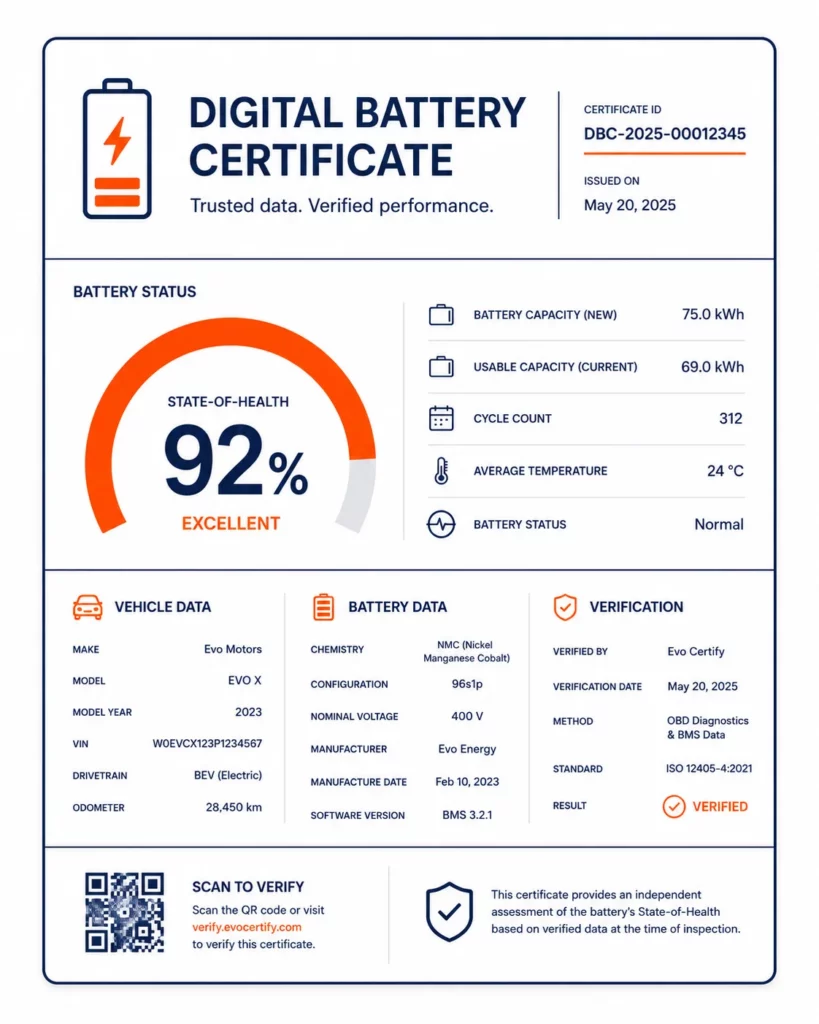
Table of contents
What a battery certificate proves for an electric car
A battery certificate documents the so-called State of Health (SoH) – the health of the traction battery. The SoH indicates as a percentage how much of the original capacity is still available after use and ageing. Put simply, a value of 90 percent means: the battery still stores around nine tenths of its capacity when new. We explain what lies behind the SoH value technically in our article on the SoH battery.
In addition to the pure SoH value, a meaningful certificate usually contains the vehicle identification number (VIN), the test date, the measurement method used and, depending on the provider, an assessment of the remaining range. Reputable certificates are issued as a digitally signed PDF and are thus protected against subsequent changes.
Important for context: The methods assess the condition of the battery as a system. Depending on the method, they use data from the battery management system (BMS) or their own measurements. With the VIN query, the values come directly from the manufacturer’s systems.
A battery certificate turns the biggest uncertainty factor of a used electric car – the condition of the battery – into a documented, traceable key figure.
Why the proof matters for dealers, fleets and rental companies
Residual value and resale value
The traction battery accounts for a considerable part of the vehicle’s value – 40 to 50 percent, depending on the estimate. (Source: AUTO BILD / Federal Ministry for Economic Affairs) Its condition therefore has a strong impact on the price. With the EV value correction, Deutsche Automobil Treuhand (DAT) has introduced a standardised procedure that incorporates the actually determined SoH value into the vehicle valuation that is decisive for the trade. (Source: DAT) A documented, good SoH value is thus a direct lever on the calculable residual value. We look in more detail at how the remaining capacity specifically affects valuation and purchase price in our article on battery remaining capacity.
Added to this is the warranty relevance: with many manufacturer warranties, the SoH must not fall below a threshold of around 70 percent. (Source: Autogazette) A documented value therefore also shows how much warranty buffer a vehicle still has – a practical argument both when buying and when selling.
Trust and liability
Buyers reward transparency. According to the DAT Report 2025, around 44 percent of used car buyers would like a battery certificate to safeguard their purchase decision. (Source: DAT) The portal mobile.de now requires an existing certificate to be uploaded if it is used in advertising. (Source: heise) For the trade, proof specifically means: fewer discussions in the sales conversation, cleaner documentation for the buyer and a lower risk of later complaints about the battery.
Which methods are available – a comparison
Today there are essentially three ways to obtain a battery certificate for an electric car. They differ significantly in effort, duration and suitability for everyday trading.
Physical test on the vehicle
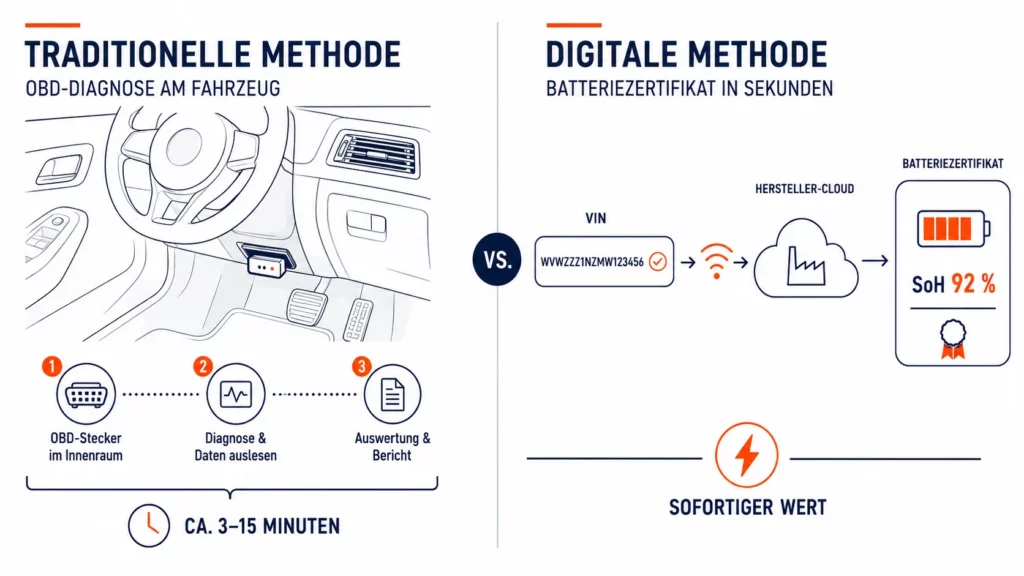
In the classic method, the vehicle is connected to a diagnostic device via the OBD interface. In the detailed variant, the battery is discharged over several days from full to around ten percent without recharging in between; the certificate is then available after one to two working days. There are now also significantly faster variants that determine the condition in a few minutes via plug-and-play. What all physical methods have in common: a device must be connected to the vehicle on site.
There is a trade-off between the two variants: the discharge drive is considered particularly thorough because it captures the real charging and discharging behaviour of the battery – but it requires a separate device per vehicle and a collection period of several days of normal use until the certificate is available. For a single, high-value vehicle, this effort can be worthwhile. For a larger stock or a fleet, it hardly scales: a hundred vehicles mean a hundred devices, a hundred collection periods – and no overview of the entire stock at a glance.
Manufacturer data via VIN (over-the-air)
A second method uses the data that the vehicle manufacturer records anyway. The SoH value is retrieved via the VIN directly from the manufacturer’s systems – without a diagnostic device, without a discharge drive and without the vehicle being taken out of service. The value is available immediately.
An important distinction is worthwhile here: the result is a report of the values transmitted by the battery management system (BMS) and determined by the manufacturer – not a measurement of the provider’s own. This must be distinguished from the formally certified battery test result (for example according to the CARA standard), which constitutes recognised proof. A fast VIN report and a formal certificate are therefore not the same, but two complementary levels.
Self-reading via OBD adapter
With an OBD2 adapter and a suitable app, an approximate SoH value can sometimes be read out yourself. This is inexpensive, but does not provide a standardised, signed certificate and its reliability varies depending on the model and app – it is therefore only of limited suitability for a reliable valuation in the trade.
| Method | Device / effort | Time to result | Vehicle blocked? | Suitability for trade / fleet |
|---|---|---|---|---|
| Physical test (on the vehicle) | Diagnostic device via OBD, on site | a few minutes to several days (depending on variant) | Device must be connected | good for individual vehicles, more effort for stock |
| Manufacturer data via VIN (OTA) | none, only VIN | immediately | no | suitable for individual vehicles and entire stock |
| Self-reading via OBD | OBD2 adapter + app | a few minutes | no | only rough self-assessment, no certificate |
Regardless of the method: a single SoH value is only truly meaningful in relation to age, mileage and comparable vehicles – the right classification is decisive.

We are the experts for innovative battery solutions in the EV market. Let’s talk.
Using the battery certificate in the purchasing and sales process
Checking proof when buying
It is worth looking at the battery condition as early as the purchase. If a current certificate is available, the SoH value can be factored directly into the valuation. If not, you should determine the value yourself before setting the purchase price – otherwise you are buying in a risk that you have not quantified.
Organising certificates for the entire stock
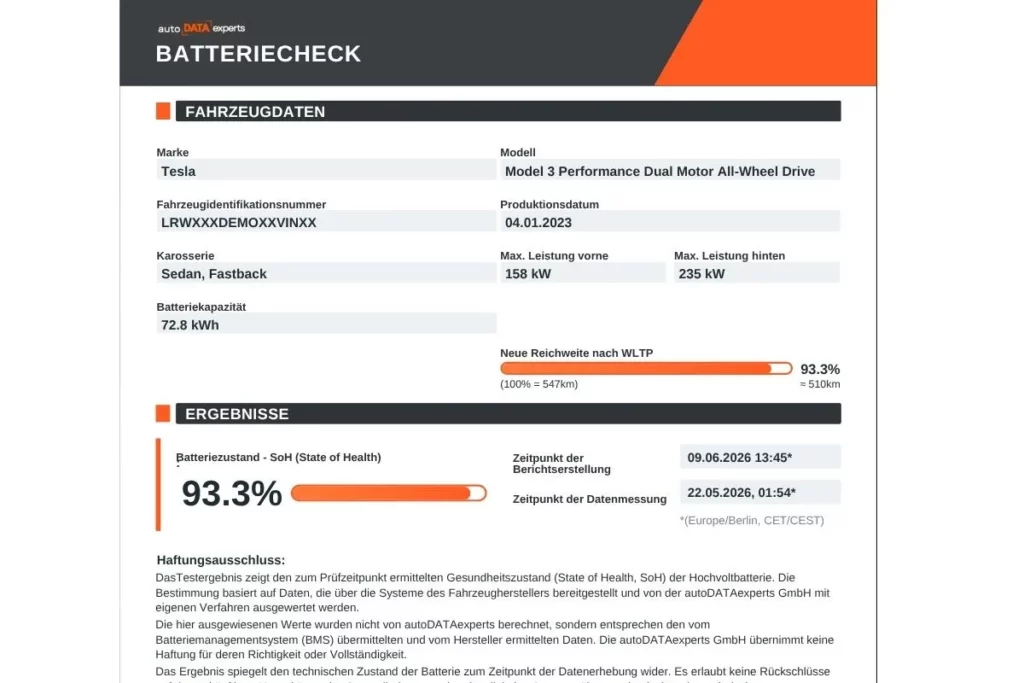
In everyday trading, the individual test matters less than the question: how do I ensure that every EV in stock has current proof – without it taking days? This is exactly where SoH OTA from autoDATAexperts comes in: via the VIN, the battery condition is retrieved directly from the manufacturer’s systems – without a diagnostic device, without a discharge drive, without a workshop visit. An employee enters the VIN and receives the SoH value as a battery check report; billing is per query. For formally recognised proof, autoDATAexperts, as a member of the CARA Europe association, also offers fully CARA-certified battery tests. In this way, the fast report for the current stock can be combined with the certified test for particularly valuable vehicles. The article on the SoH query via VIN describes how the VIN retrieval works technically. The legal significance of a documented SoH value from the day of handover in a warranty claim is shown in the article on electric car battery warranty.
Securing documentation and liability
Complete documentation of the battery condition is above all a question of risk reduction. Anyone who records the SoH value for each vehicle can prove it in the sales conversation, include it in the vehicle file and refer to a documented status in the event of a dispute. This does not replace legal advice: whether and how you use battery data bindingly in purchase contracts, for warranty claims or vis-à-vis lessors is best clarified with your own legal advisor. There is currently no general obligation to certify every used electric car – but reliable proof gives you a clear advantage in terms of transparency and trust.
- When buying: check or determine the SoH value before the purchase price is set
- In stock: generate current proof for every supported EV
- When selling: actively show the certificate in the listing and in the conversation
- In the file: document SoH value, test date and VIN
- In the process: define clear responsibility and a uniform procedure for employees
- Legal: coordinate use in contracts with your own legal advisor
In the trade, it is not the individual test that counts, but a repeatable process: every vehicle in stock should reach a documented battery condition in just a few steps.
EU battery passport from 2027: what is coming for the trade
With the EU Battery Regulation (Regulation (EU) 2023/1542), the digital battery passport is coming: according to the German Federal Environment Ministry, it will become mandatory from 18 February 2027 and documents the origin, composition and condition of a battery over its life cycle. (Source: Federal Environment Ministry) Important for differentiation: the battery passport is a regulatory obligation, primarily on the manufacturer side, covering the entire life cycle. Today’s battery certificate, on the other hand, is a voluntary, point-in-time proof of the current condition that dealers can already use now. Anyone who already incorporates the documented battery condition into their processes today is prepared for the upcoming requirements instead of being surprised by them.
Conclusion
A battery certificate for the electric car makes the decisive value driver of an EV visible – and thus creates certainty when buying, trust when selling and a reliable residual value. For the trade, the individual method matters less than organising proof as a repeatable process across the entire stock. We are happy to discuss in a direct conversation how this can be integrated into your processes without diagnostic devices and downtime.
OverTheAir by autoDATAexperts
The battery health comes to you.
Not the other way around.
Enter the VIN, receive the SoH report – without the vehicle on site. €29 per query, no subscription.
Register for freeFAQ
What is a battery certificate for an electric car?
A battery certificate documents the health (State of Health, SoH) of the traction battery as a percentage of the original capacity. It usually contains the VIN, the test date and the measurement method and is usually issued as a digitally signed PDF. The condition of the battery is assessed as a system. For the trade, it is proof that makes the value and condition of a used electric car verifiable.
Is a battery certificate mandatory when selling a used car?
No, there is currently no general certification requirement. However, individual platforms require an existing certificate to be uploaded if it is used in advertising. (Source: heise) Regardless of this, proof increases transparency and trust. You should clarify legal questions about its use in contracts with your own legal advisor.
How does the EU battery passport differ from the battery certificate?
The EU battery passport is a regulatory documentation, primarily on the manufacturer side, covering the entire life cycle of a battery and will become mandatory from 18 February 2027. (Source: Federal Environment Ministry) The battery certificate, on the other hand, is a voluntary, point-in-time proof of the current condition that dealers can already use today. The two complement each other: anyone who documents today is prepared for the future obligation.