


Table of contents
The SoH battery assessment has evolved from a side issue into a key metric in the used electric vehicle trade. While mileage and year of manufacture dominate the valuation of combustion cars, it is above all the condition of the high-voltage battery that determines an electric car’s range, residual value and saleability. SoH is the abbreviation for State of Health – in other words, the battery’s health condition. This article explains what exactly lies behind the value, how it is determined, which values are considered good and why SoH is becoming the decisive valuation metric for dealers, fleet operators and rental companies.
What is battery SoH? Meaning and definition
The SoH value of a battery describes how much capacity and performance a high-voltage battery still has compared with its new condition. By definition, a brand-new battery has an SoH of 100 percent. This value decreases with every charge and discharge cycle, with every year of service and with every thermal load.
A simple example: an electric vehicle with 60 kWh of usable gross capacity when new and a real-world range of 400 kilometers is tested after a few years and shows an SoH of 88 percent. Mathematically, the battery still has around 53 kWh – and the range drops accordingly to around 350 kilometers. In practice, other factors also play a role (temperature, driving style, tires), but SoH provides the most reliable basis for assessing value.
Important: SoH is not the same as SoC. While the State of Health (SoH) describes the long-term health of the battery, the State of Charge (SoC) indicates the current charge level in percent – i.e. how full the battery is right now. In the cockpit of an electric car, the driver usually sees the SoC. The SoH, on the other hand, is stored deeper in the battery management system (BMS) and is not displayed by default.
How does a battery age? The two paths of degradation
The gradual deterioration of battery performance is called degradation. It follows two parallel paths that do not exclude each other but overlap.
Calendar aging: The battery ages simply through the passage of time – even when the vehicle is not used. Chemical processes in the cells cause active material to be lost. High temperatures and a consistently high state of charge accelerate this process significantly.
Cyclic aging: Every full charge and discharge cycle puts mechanical and chemical stress on the cells. Lithium ions move back and forth between the electrodes, and over time metallic compounds are deposited that reduce the usable capacity.
The most important factors influencing both forms of aging:
- Temperature: Heat above 35 degrees Celsius accelerates aging considerably
- Fast charging (DC): Frequent charging at high power above 100 kW generates heat and mechanical stress
- State-of-charge management: Permanently charging to 100 percent or deep discharging below 10 percent damages the cells
- Driving style: Hard acceleration and full-throttle driving put more short-term stress on the cells
- Idle times: Long periods of parking at a high state of charge and high temperatures are particularly critical
For the vehicle trade, this means: two identical vehicles with the same mileage can have very different SoH values – depending solely on how they were used and maintained.
Understanding SoH is one thing – documenting it for your own vehicles is another.
What is a good SoH value? Guide values and warranty thresholds
There is no industry-wide minimum value below which a battery is considered “defective”. In practice, however, guide ranges have become established that are helpful for valuation in the trade:
| SoH range | Rating | Practical relevance |
|---|---|---|
| 95–100 % | Very good | New car or young used vehicle, full functionality |
| 85–95 % | Good | Typical for used cars with 2–5 years of use |
| 70–85 % | Acceptable | Range noticeably reduced, price adjustment required |
| Below 70 % | Critical | Warranty claim with most manufacturers, economic viability questionable |
Most vehicle manufacturers offer a battery warranty of 8 years or 160,000 kilometers with a guaranteed minimum SoH of 70 percent. If the value falls below this within that period, the manufacturer usually covers replacement or repair. This is important information for purchase valuation – a vehicle with a documented low SoH within the warranty period can, under certain circumstances, be bought at a considerable value advantage.
The encouraging news: large-scale analyses of SoH measurements show that EV batteries are considerably more robust than the market assumed for a long time – but that is precisely why individual proof is so valuable: it makes the difference between a stable vehicle and a statistical outlier transparent.
How is battery SoH determined? An overview of methods
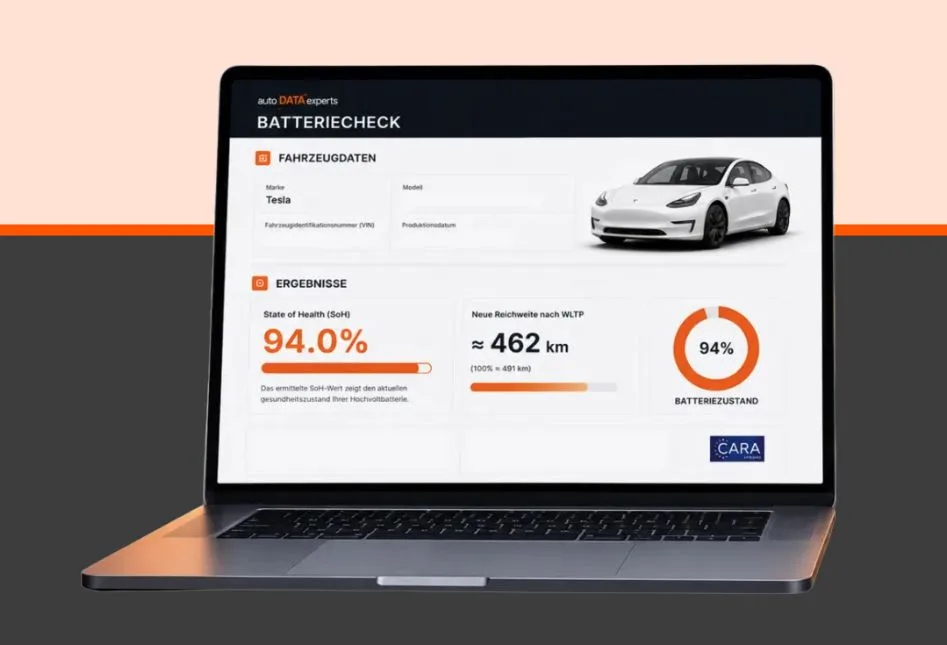
There is no single standard way to determine a battery’s SoH. Three main methods have become established on the market, and they differ significantly in effort, accuracy and practicality.
OBD-based read-out
A diagnostic device is connected via the vehicle’s OBD interface and reads the SoH value directly from the battery management system (BMS). The process is quick and inexpensive. The drawback: the value read out comes from the manufacturer, and the algorithm behind it is not disclosed. Different manufacturers calculate SoH differently, so a direct comparison between brands is only possible to a limited extent.
Dynamic discharge measurement
With this method, the battery is stressed under controlled conditions – i.e. deliberately charged and discharged. Specialized providers carry out such tests and issue a manufacturer-independent certificate. The advantage: greater comparability and a more accurate result. The drawback: a more complex process, the vehicle is usually tied up for several days, and the method requires a certain minimum charging infrastructure.
OTA-based VIN query
The most recent method uses the data communication that already exists between the vehicle and the manufacturer. Via an over-the-air connection, the manufacturer supplies the SoH value directly on request – the vehicle is identified by its vehicle identification number (VIN). How this data transfer works technically is described in detail in our basic article on OTA updates in cars. The advantage: no device, no workshop visit, and the result is available in seconds. The drawback: availability depends on whether the manufacturer provides the corresponding interface – currently this is the case for selected models from Tesla, BMW, Mazda and the VW Group.
| Method | Duration | Effort | Scalability | Comparability |
|---|---|---|---|---|
| OBD read-out | A few minutes | Diagnostic device required on site | One vehicle at a time | Manufacturer-dependent |
| Dynamic discharge measurement | Several hours to days | Hardware + charging infrastructure | Limited | High (manufacturer-independent) |
| OTA-based VIN query | Seconds | Browser access is sufficient | Very high (including for portfolios) | Manufacturer data directly |
With SoH OverTheAir, autoDATAexperts has implemented an OTA-based VIN query for the B2B vehicle trade. Which of the three methods is the right one depends on the use case: for a quick purchase decision on site or for the preliminary assessment of an entire portfolio, the OTA query is the fastest route. For court-proof, manufacturer-independent certificates, dynamic measurement remains the gold standard.
Battery SoH in the vehicle trade: impact on residual value and purchasing
In the B2B vehicle trade, SoH has evolved within just a few years from a technical side note into a central valuation criterion. Deutsche Automobil Treuhand (DAT) has included SoH in its SilverDAT 3 software as an official valuation criterion for used electric vehicles. As a result, the battery condition feeds directly into the residual value calculation – a step that had never before been taken for the condition of a single component in decades.
For day-to-day purchasing in the used car trade, this has concrete consequences:
- A documented SoH replaces gut feeling. Valuations become reliable, purchasing becomes less risky.
- In sales conversations, SoH becomes an argument. Anyone who knows the value can negotiate in a targeted way – or actively communicate a good value.
- Online portals are following suit. On Mobile.de and similar platforms, vehicles with a documented SoH are increasingly given preferential display and are in greater demand.
- Lease returns are becoming more transparent. When fleet vehicles are revalued on return, discussions about the actual condition of the battery are no longer necessary.
Dealers who trade without an SoH assessment today are working with an incomplete information base. Those who systematically include SoH gain a measurable advantage – both when purchasing and when reselling.
What changes with the Euro 7 regulation?
The Euro 7 standard introduces binding minimum requirements for the durability of traction batteries for the first time – making battery condition part of type approval. For purely electric passenger cars (category M1): after five years or 100,000 kilometers, the battery must still retain at least 80 percent of its original capacity, and after eight years or 160,000 kilometers at least around 72 percent (source: Regulation (EU) 2024/1257 – Euro 7).
The regulation introduces two new metrics that complement the classic SoH value:
- SoCE (State of Certified Energy) – the certified amount of energy still available in the battery
- SoCR (State of Certified Range) – the certified range still achievable
Manufacturers must document both values and make them available to vehicle owners during operation via a digital vehicle passport.
On the timeline: the Euro 7 requirements initially apply to newly type-approved models from 29 November 2026; for all newly registered passenger cars, they apply from 29 November 2027 (source: Regulation (EU) 2024/1257; auto motor und sport).
For the trade, this means: data transparency is increasing, and in the coming years SoH will become the standard benchmark in the used car market. Those who already work with SoH data today build up routine before the obligation takes effect – and position themselves as a professional provider in the market.
Conclusion
The SoH battery assessment is no longer a technical gimmick in the B2B vehicle trade, but a business necessity. The State of Health provides the only reliable answer to the question of how much residual value a high-voltage battery actually still has. Which SoH determination method is right in an individual case depends on the use case: for quick valuation in the purchasing process or the preliminary check of larger portfolios, the OTA-based VIN query offers a practical route because it works without a device and without a workshop visit. Tools such as SoH OverTheAir from autoDATAexperts show how this method can be integrated concretely into the day-to-day work of dealers, fleets and rental companies.
Would you like to better assess how battery data can be integrated into your purchasing or valuation process? autoDATAexperts supports dealers, fleets and rental companies in making efficient use of the SoH value via VIN query – a no-obligation introductory call will clarify within a few minutes whether this fits your use case.
OverTheAir by autoDATAexperts
The battery health comes to you.
Not the other way around.
Enter the VIN, receive the SoH report – without the vehicle on site. €29 per query, no subscription.
Register for freeFAQ
What does the abbreviation SoH stand for in a battery?
SoH stands for “State of Health”. The value indicates, as a percentage, how much capacity and performance a high-voltage battery still has compared with its new condition. An SoH of 100 percent corresponds to a brand-new battery; an SoH of 85 percent means that the battery still delivers 85 percent of its original capacity.
How is the SoH value of a battery determined?
There are three established methods: first, the OBD-based read-out, in which a diagnostic device reads the value directly from the battery management system. Second, dynamic discharge measurement, in which the battery is stressed and measured under controlled conditions – this delivers a manufacturer-independent certificate. Third, the OTA-based VIN query, in which the value is retrieved directly from the manufacturer. Which method is suitable depends on the use case, time frame and required accuracy.
What SoH value is still acceptable when buying a used car?
Values between 85 and 95 percent are considered good for vehicles that are two to five years old. Between 70 and 85 percent, the SoH is still acceptable but should be reflected in the price. Below 70 percent, the battery warranty applies with most manufacturers – a vehicle with a documented lower value within the warranty period can be an attractive purchase thanks to the warranty claim.
Why is SoH more important than mileage?
In an electric car, the high-voltage battery accounts for a considerable share of the vehicle’s value. Unlike with combustion cars, mileage alone says little about the actual battery condition – two identical vehicles with the same mileage can have very different SoH values, depending on how they were charged, driven and stored. SoH is therefore a more reliable valuation metric than the odometer reading.