

Two structurally identical electric vehicles, same year of registration, almost identical mileage – and yet their residual capacities are several percentage points apart. When buying in, this is not a detail but a four-figure sum. Battery condition assessment for electric vehicles therefore replaces estimation with a measurable figure: the State of Health (SoH). This article covers which data a reliable assessment needs, the two ways in which it is collected and how to interpret the result for purchasing, fleet management and lease returns.
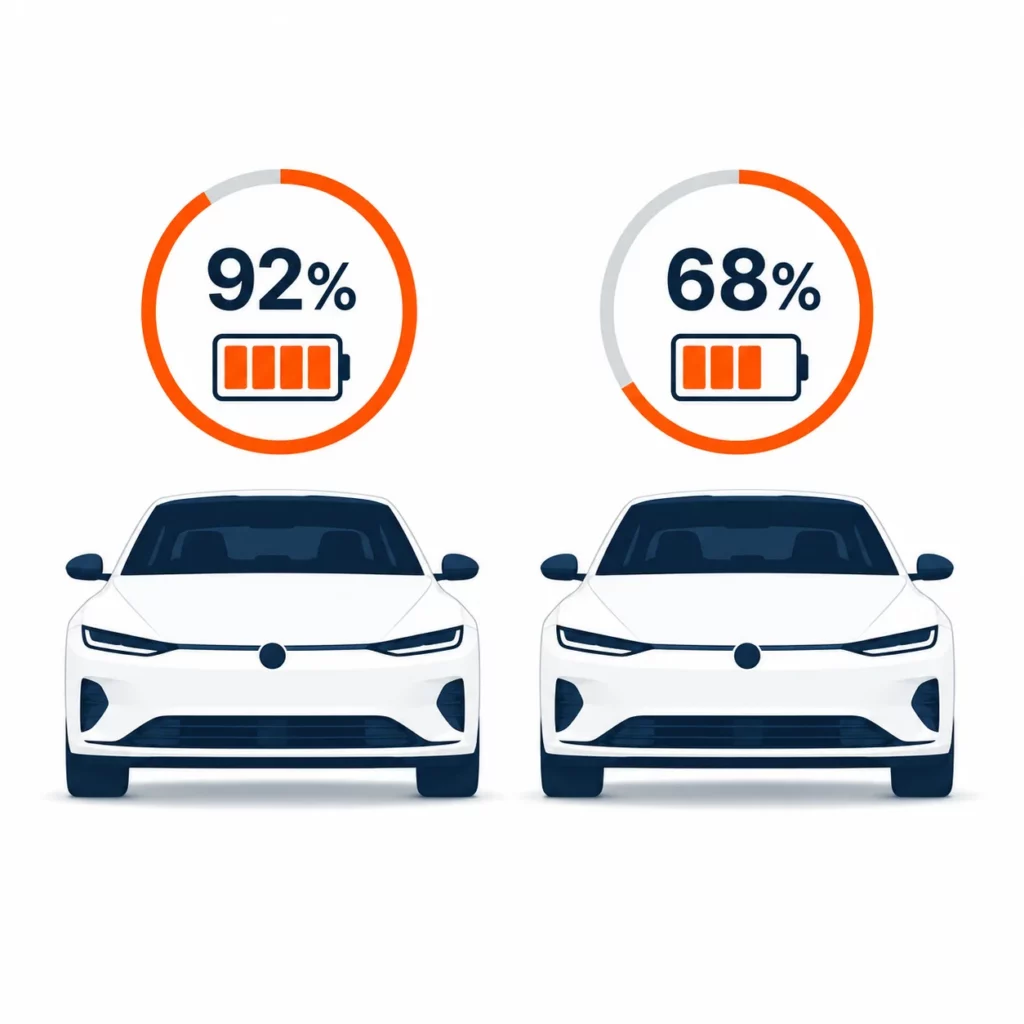
Table of contents
Why battery condition assessment determines the vehicle’s value
For a combustion-engine car, mileage, age, equipment and body condition account for most of the valuation. With an electric vehicle, one component is added that overrides everything else: the traction battery. The German valuation organisation Deutsche Automobil Treuhand (DAT) names it as the most expensive component of an electric car, whose health has a decisive influence on the residual value.
DAT has turned this into a standardised procedure – the so-called EV value correction in the SilverDAT valuation software. It calculates from vehicle age and mileage which SoH a vehicle should ideally have and compares this target SoH with the actual SoH measured. The deviation is shown directly in euros – as a reduction or an increase in value. The manufacturer’s warranty conditions, the battery capacity and the cost of battery replacement are also factored into the calculation.
In practice, this means: without a reliable actual SoH, any valuation of an electric vehicle remains incomplete. Mileage alone does not tell the story. The role the documented SoH plays in complaints is explained in the article on electric car battery warranty.
The target/actual comparison is the real core of the condition assessment. What matters is not the absolute SoH value, but its deviation from what age and mileage would lead one to expect.
What is measured in a battery condition assessment
State of Health (SoH) – the key metric
The SoH describes how much usable capacity a high-voltage battery still has compared with its new condition. A brand-new battery by definition has an SoH of 100 percent. In professional vehicle valuation, the value is recorded as a percentage with one decimal place.
As a rough guide for classifying a used vehicle, the following ranges have become established in practice:
| SoH range | Classification |
|---|---|
| 95–100 % | Close to new condition, mostly young vehicles or low mileage |
| 85–95 % | Good condition, typical for vehicles two to five years old |
| 70–85 % | Still acceptable, but should be reflected in the price |
| below 70 % | Within the warranty period, often a warranty case |
The last point is economically relevant: many manufacturers guarantee that the high-voltage battery will not fall below a minimum SoH of 70 percent within eight years or 160,000 kilometres. A documented value below this can trigger a claim within this period – turning a supposed problem vehicle into a calculable purchase.
Degradation – why and how batteries age
The SoH decreases over time for two overlapping reasons. Calendar ageing takes place regardless of use: the electrolyte, anode and cathode are subject to chemical decomposition processes, and the time elapsed since production alone has an effect. Prolonged parking with a very low state of charge is unfavourable, especially in cold conditions.
Cyclic ageing results from charging and discharging. The decisive factors here are the type and frequency of charging cycles, the depth of discharge, the charging power and the temperature. Frequent DC fast charging and regularly using the full capacity accelerate degradation; gentle AC charging and operation mainly between 20 and 80 percent state of charge slow it down.
This is exactly why mileage says so little. Two vehicles with identical mileage can differ significantly depending on charging behaviour, temperature history and usage profile – and only a measurement makes this difference visible.
Two ways to determine the SoH: over the air or on site at the vehicle
The SoH is the metric. How you obtain it, on the other hand, is an organisational decision – and it varies depending on location, number of vehicles and time window.
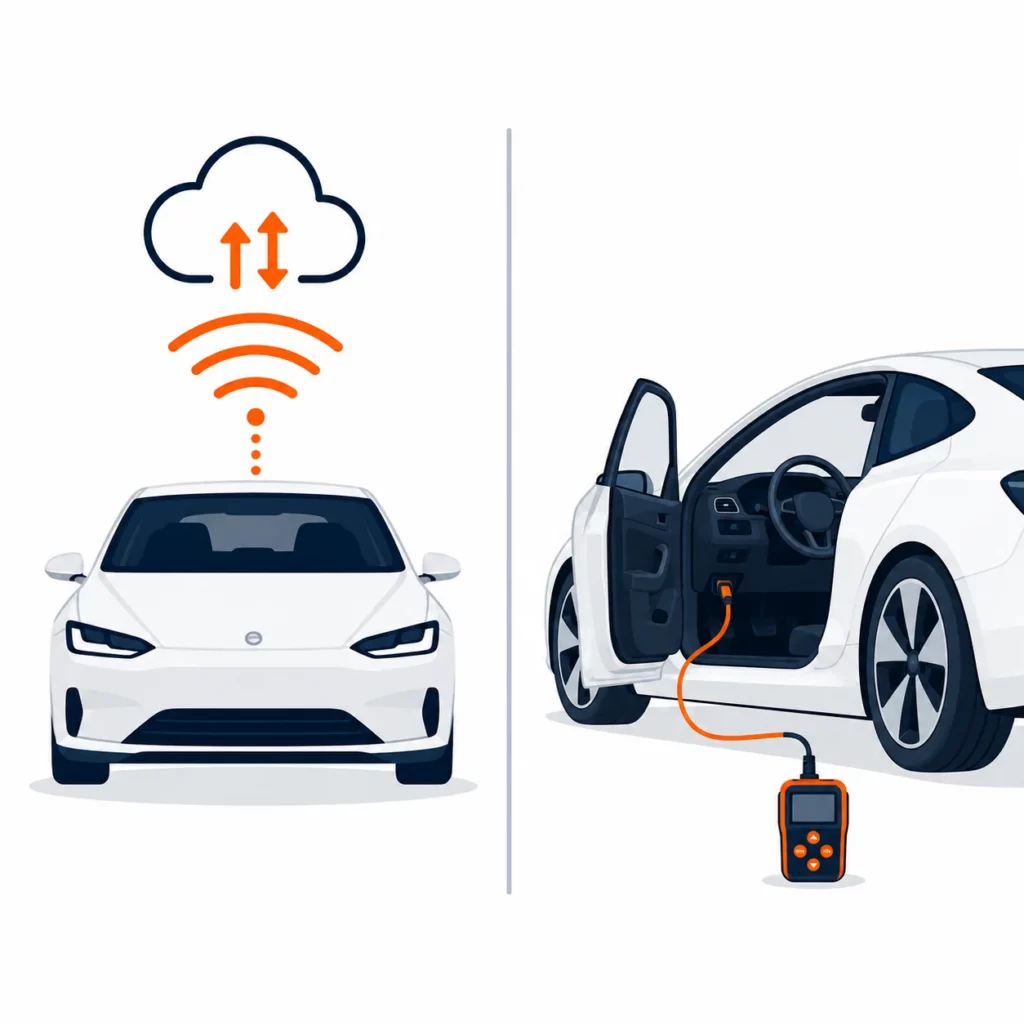
SoH query over the air via VIN
With this method, the battery condition is retrieved from the vehicle manufacturer’s backend. The vehicle is identified by its vehicle identification number (VIN). No diagnostic device is connected, no workshop appointment is needed and no test drive is carried out – the vehicle does not even have to be in the same place as the person triggering the query. Query SoH via VIN
This is exactly the method autoDATAexperts offers with SoH OTA: enter the VIN, receive the value. Currently supported are Tesla with almost all models, many models from BMW and Mazda, and vehicles of the VAG Group from 09/2024 – these include the VW ID.3, ID.4, ID.5, ID.7, ID.7 Tourer and ID.Buzz, CUPRA/Seat Born and Tavascan, Skoda Elroq, Enyaq and Enyaq Coupé, and the Audi Q4 e-tron. Further manufacturers and models are being added continuously.
The advantage lies in scalability: a fleet or a remote purchase can be assessed across locations in a short time. The limit lies in model coverage – not every vehicle on the market can yet be reached this way.
On-site test directly at the vehicle
The alternative is reading the data at the vehicle itself. A diagnostic device is connected to the OBD interface and reads the battery data directly from the vehicle. Depending on the method, the result is available after a few minutes; more elaborate methods that evaluate a complete charging or discharging cycle take considerably longer.
This method is always the right choice when the vehicle is physically on site anyway, when proof is needed immediately during the purchase conversation, or when the model is not yet covered by the manufacturer query.
The two methods in direct comparison
| Method | Datenzugang | Hardware needed at the vehicle? | Duration | When it makes sense |
|---|---|---|---|---|
| Over the air (via VIN) | Manufacturer data, retrieved remotely | No | Very fast | Multiple locations, fleet valuation, remote purchasing |
| On-site test (diagnostic device) | Read directly at the vehicle | Yes | A few minutes to several hours depending on the method | Vehicle is on site, immediate proof, models without OTA coverage |

Battery condition via VIN query or over the air? We are happy to advise you!
Manufacturer-based and independent data: what matters for reliability
To date, there is no uniformly prescribed test procedure for determining the SoH. Various solutions are in use on the market, differing in data source, calculation model and test duration. This has a consequence that is often overlooked in practice: two values for the same vehicle are not automatically the same statement.
Manufacturer-based data comes from the battery management system and its long-term history. It is close to the source and consistent within a brand because it is generated according to the same logic. Independently collected measurements, on the other hand, follow their own model that is the same across brands – they are comparable with each other, even across manufacturers.
Both approaches have their justification. What matters for reliability is less the question of which method is the “right” one, but whether the origin of the value is documented. DAT takes this into account by accepting both test results according to manufacturer specifications and results from independent diagnostic procedures as input values in its valuation system.
A reliable condition assessment includes not only the value but also information on how it was determined. An SoH without a stated method is a number, not proof.
What the assessed condition means for your decision
The condition assessment is not an end in itself. Depending on the role, it answers a different question:
- Purchasing: determine the SoH before setting the price, not afterwards. A documented value is a selling point on resale – and protects against renegotiation.
- Fleet management: for vehicles of comparable age, the SoH determines the order in which they are defleeted. Vehicles with noticeable degradation should be remarketed earlier.
- Lease returns: a value collected at the time of return creates a shared factual basis between lessor and lessee before deductions are discussed. Our process guide shows exactly how the SoH fits into the return protocol and the remarketing of electric car lease returns.
- Portfolio valuation: for larger portfolios, a comprehensive query shows where value risks lie in the portfolio – long before they show up in days in stock.
How a specific SoH value affects the vehicle value in euros is a separate question. It depends on the model, age, remaining warranty period and battery replacement cost – and is covered in detail in our article on the residual capacity and valuation of the electric car battery.
Outlook: battery passport and proof requirement from 2027
The digital battery passport applies in the EU from 18 February 2027. Articles 77 and 78 of the EU Battery Regulation (EU) 2023/1542 stipulate that traction batteries for electric vehicles as well as industrial and LMT batteries with a capacity of more than two kilowatt hours may only be placed on the market with a digital data record accessible via QR code. Among other things, it will contain information on origin, composition and performance and durability parameters.
One point is often overlooked: the obligation applies to batteries newly placed on the market from this cut-off date. Today’s used vehicle stock will therefore not retroactively receive proof. For all vehicles that you buy, defleet or take back in the coming years, your own condition assessment therefore remains the method of choice – the battery passport will complement it in future, but will not replace it.
Conclusion
Battery condition assessment turns an unknown into a metric. What matters is not only the SoH value but its relationship to what age and mileage would lead one to expect – and the question of how the value was obtained. Whether you retrieve it over the air via VIN or collect it on site at the vehicle depends on where the vehicle is and how many vehicles you are assessing. We would be happy to discuss in a direct conversation how both fit into your existing purchasing and valuation processes.
OverTheAir by autoDATAexperts
The battery health comes to you.
Not the other way around.
Enter the VIN, receive the SoH report – without the vehicle on site. €29 per query, no subscription.
Register for freeFAQ
How is the battery condition of an electric vehicle assessed professionally?
The basis is the State of Health (SoH) – the share of capacity still available compared with the new condition, expressed as a percentage. This measured actual value is compared with a target value derived from vehicle age and mileage. The actual assessment results from the deviation between the two. Warranty conditions, battery capacity and the cost of a possible battery replacement are also taken into account.
What data does a reliable condition assessment need?
What is needed is the measured SoH value, the vehicle identification number for unambiguous assignment, vehicle age and mileage, and the manufacturer’s warranty conditions. Equally important is documentation of how the SoH was determined – via manufacturer data or via a measurement at the vehicle. Without this information, the value is only comparable to a limited extent.
How does the condition assessment differ from residual value determination?
The condition assessment answers the technical question: what condition is the battery in, and how reliable is this statement? Residual value determination answers the commercial question: what is the vehicle worth in euros in this condition? The condition assessment therefore provides the input value, the residual value determination the result. Both steps belong together but are methodologically separate.
Will the digital battery passport replace the condition assessment from 2027?
No. The digital battery passport becomes mandatory from 18 February 2027 for newly placed traction batteries and contains, among other things, performance and durability parameters. However, vehicles that are already in stock or on the market today will not receive retroactive proof. For the used car trade and fleet management, your own condition assessment therefore remains necessary for the foreseeable future.