

When buying a used electric car, a single value decides between profit and loss: the battery health. OTA battery diagnostics make exactly this value visible – over the air, i.e. wirelessly, without the vehicle having to go to a workshop. For dealers, fleets and rental companies, this is the difference between a well-founded valuation and an expensive blind purchase. Unlike the mileage, the bodywork reveals nothing about the health of the traction battery. This article explains what OTA battery diagnostics are, how they work and why they replace the classic battery test in many cases.
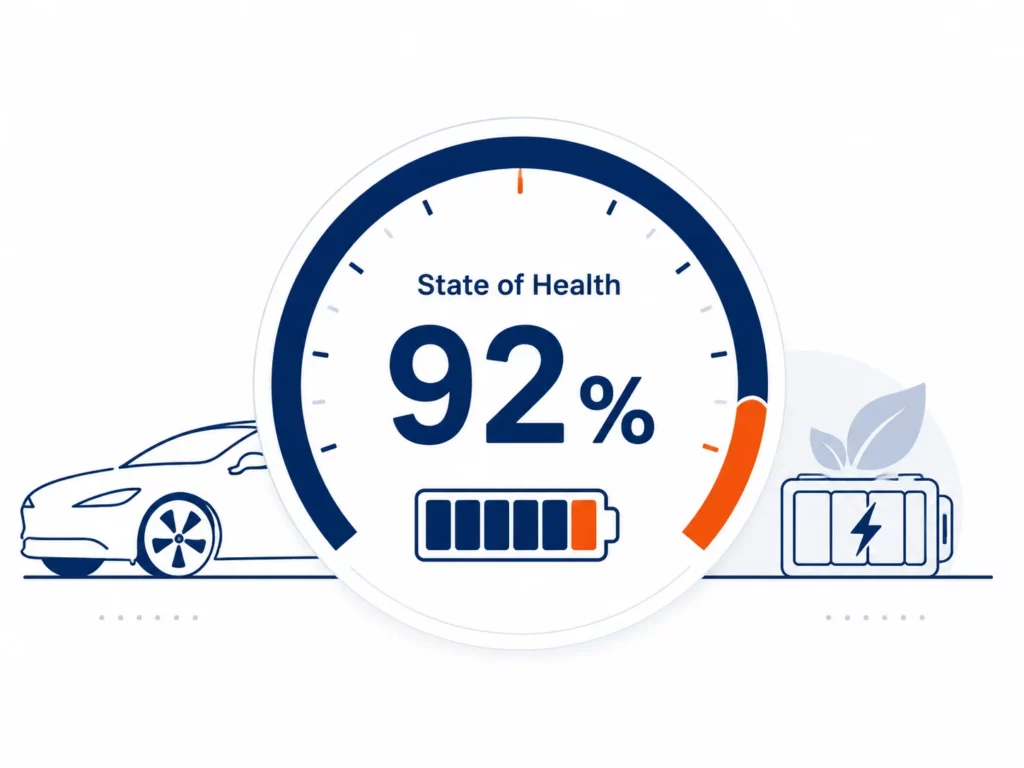
Table of contents
What are OTA battery diagnostics?
OTA battery diagnostics determine the health of the traction battery of an electric or hybrid vehicle via a wireless connection – without cables, without a diagnostic device and without a workshop visit. The abbreviation OTA stands for “over the air”, i.e. the wireless transmission of data.
The key metric here is the State of Health (SoH) – the health of the battery. It compares the amount of energy that can still be drawn today with the capacity when new and states as a percentage how much remaining capacity the battery still has. A new car starts at 100 %, and the value falls over the years and with charging cycles.
The difference from the common test methods lies in the method: instead of reading the data from the vehicle via the diagnostic socket (OBD), OTA diagnostics retrieve the battery health remotely. What this means in concrete terms for speed and effort is shown in the direct comparison below.
We clarify in advance whether your vehicles can be queried via VIN. The list of supported models is growing continuously.
Why the battery health determines value and risk
In an electric car, the traction battery is by far the most expensive component. Depending on the estimate, it accounts for 40 to 50 percent of the vehicle’s value (Source: AUTO BILD / German Federal Ministry for Economic Affairs). If it has to be replaced, it becomes correspondingly expensive.
For the trade, this means a concrete risk. Two visually identical vehicles with the same mileage can have a significantly different battery health – and therefore a different real value. Anyone who only looks at mileage and year of manufacture when buying is calculating blind.
The traction battery can account for up to 50 % of the vehicle’s value. Its condition is therefore the biggest single lever when valuing a used electric car.
This is what is at stake when buying a used electric car:
- Wrong purchase price if the battery health is unknown
- Hidden follow-up costs due to a later battery replacement
- Residual value that is hard to calculate on resale or fleet return
- Loss of buyer confidence if no reliable statement about the battery is possible
Classic battery diagnostics vs. OTA diagnostics
Two fundamentally different ways of reliably determining the battery health have become established on the market.
The classic way: OBD device and test drive
In the common physical test methods, a diagnostic device is connected to the vehicle via the OBD interface. This is followed by a test drive: the car must be fully charged and driven over several days until the state of charge falls below ten percent. The collected data is evaluated in a cloud, and the end result is a battery certificate.
The method is thorough, but has a decisive disadvantage in the trade: it ties up the vehicle for several days and requires hardware and active driving. This is often too slow for a quick purchase decision.
The OTA way: retrieval via the VIN
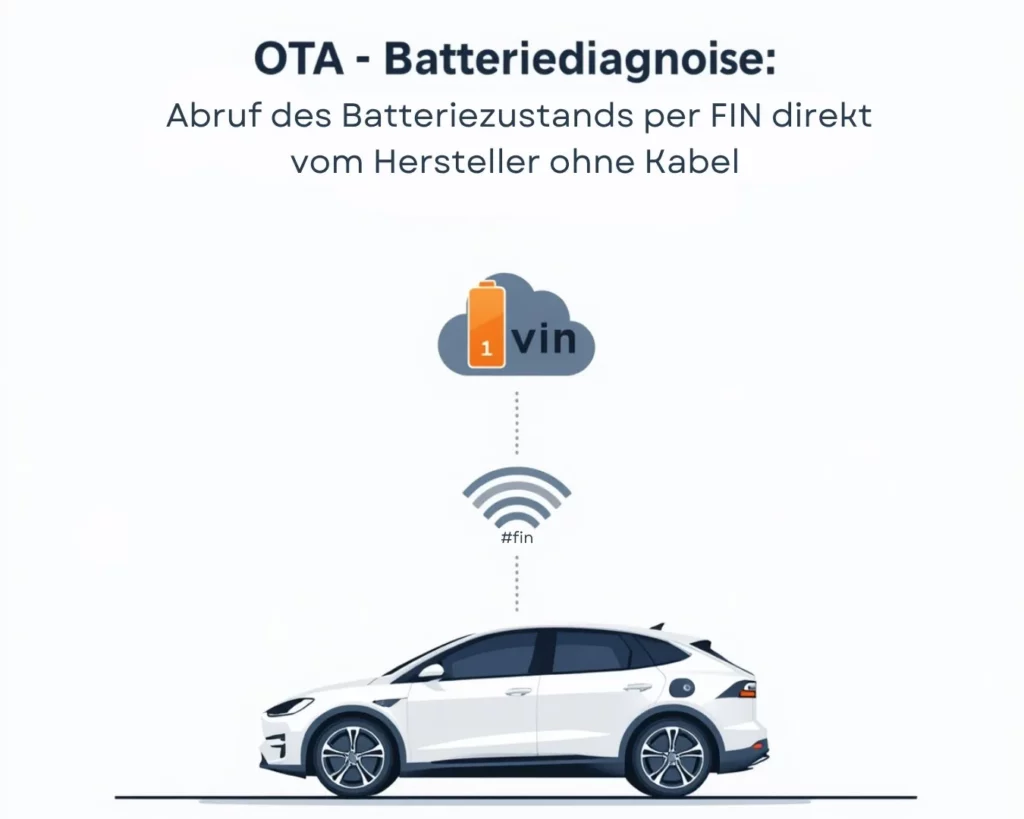
OTA diagnostics take a different route. Instead of physically measuring the vehicle, the battery health is retrieved via the vehicle identification number (VIN) – the data comes directly from the manufacturer. Neither a diagnostic device nor a test drive is needed. The SoH value is available within seconds.
This is where an often overlooked point lies: the SoH display in the vehicle itself is considered unreliable. Experts point out that the values displayed by the battery management system and the values actually measured often differ significantly (Source: Handelsblatt). OTA diagnostics that access manufacturer data avoid this problem because they do not rely on the on-board display. We have described how to check the battery health via VIN in a separate article.
| Criterion | Classic diagnostics (OBD + test drive) | OTA diagnostics (via VIN) |
|---|---|---|
| Hardware required | Diagnostic device on the OBD socket | none |
| Vehicle on site | over several days | not necessary – only the VIN |
| Time to result | several days (test drive) | Seconds |
| Data source | Read out via the vehicle bus | directly from the manufacturer |
| Effort for the dealer | high | low |
OTA diagnostics deliver the SoH value in seconds. The classic test drive ties up the vehicle for several days.
How OTA battery diagnostics work in practice
In everyday trading, the process is deliberately kept lean:
- Register and log in: The dealer receives access to the login interface.
- Enter the VIN: The vehicle identification number of the electric car to be valued is entered.
- Read the SoH value: The battery health is displayed directly.
- Billing: Billing is monthly by invoice, at 29 euros per query.
For exactly this use case, autoDATAexperts has developed SoH OTA, a solution that retrieves the battery health directly from the manufacturer via a VIN query – without a plug and without a workshop visit.
Currently supported are, among others, Tesla (almost all models), many models from BMW and Mazda, and vehicles of the VAG group from production date 09/2024: VW ID.3, ID.4, ID.5, ID.7, ID.7 Tourer and ID. Buzz, CUPRA/Seat Born and Tavascan, Skoda Elroq, Enyaq and Enyaq Coupé as well as the Audi Q4 e-tron. Further manufacturers and models are being added continuously.
Who benefits most from OTA diagnostics
The benefit is greatest wherever many vehicles have to be valued quickly and reliably:
- Used car dealers: a reliable SoH value before purchase, without tying up the vehicle for days.
- Fleet operators: realistic residual values across the entire fleet, for example for lease returns.
- Rental companies: fast condition checks when defleeting and infleeting.
If you want to understand what the determined value means, you will find the basics in our article on what the State of Health reveals about the battery.
Conclusion
Battery health is the decisive metric for a used electric car – and at the same time the hardest to grasp. OTA battery diagnostics make it available in seconds without hardware or a test drive, based on manufacturer data. This turns a gut decision at purchase into a data-driven valuation. How this fits specifically into your purchasing and valuation processes is best shown using a real vehicle example.
OverTheAir by autoDATAexperts
The battery health comes to you.
Not the other way around.
Enter the VIN, receive the SoH report – without the vehicle on site. €29 per query, no subscription.
Register for freeFAQ
What are OTA battery diagnostics?
OTA battery diagnostics determine the health (State of Health, SoH) of the traction battery of an electric or hybrid vehicle via a wireless connection. “OTA” stands for “over the air”, i.e. wireless data transmission. Unlike classic methods, neither a diagnostic device nor a test drive is needed. Instead, the battery health is retrieved remotely.
How is the battery health retrieved over the air via VIN?
The basis is the vehicle identification number (VIN). It is used to obtain the SoH value directly from the vehicle manufacturer without physically connecting the car. The dealer enters the VIN in an online interface and receives the battery health within seconds. As the data comes from the manufacturer, there is no need to rely on the often unreliable on-board display.
What are the advantages of OTA diagnostics over a battery test in the workshop?
The classic test ties up the vehicle for several days and requires an OBD diagnostic device and a test drive. OTA diagnostics, on the other hand, deliver the SoH value in seconds, without hardware and without the vehicle having to be on site. For the trade, this means faster purchase decisions and less effort per valuation.