
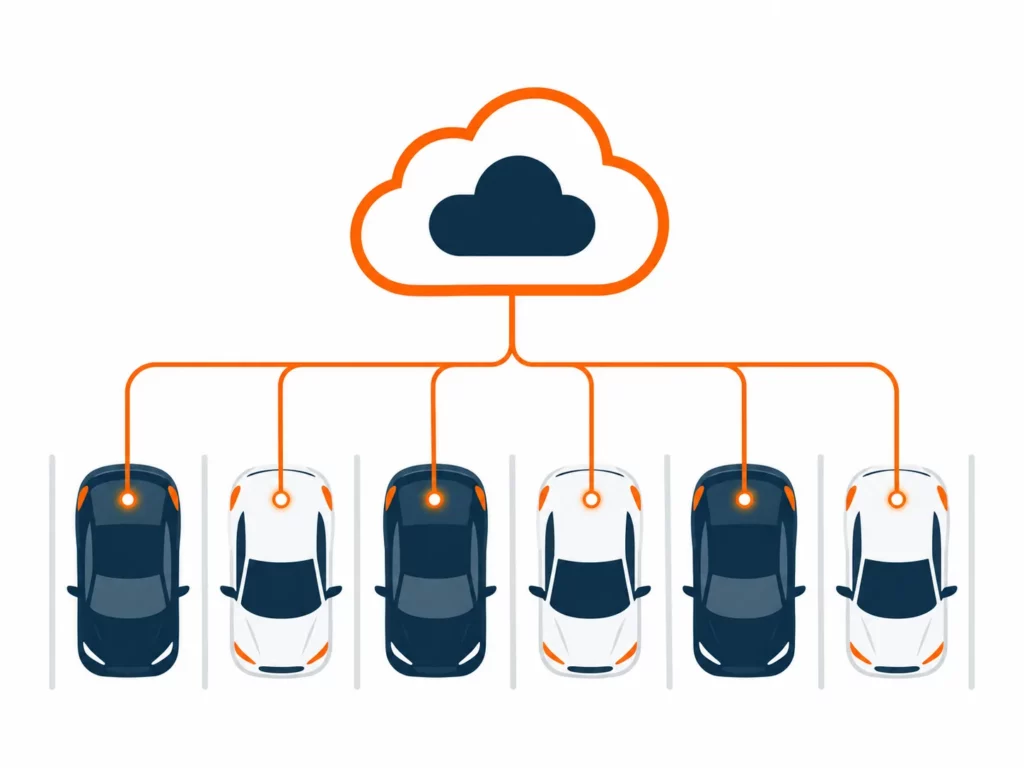

A connected car is a vehicle that is permanently connected to its manufacturer’s backend server via a built-in mobile module. Around 90 per cent of new vehicles in Europe have such connectivity features, but across the entire vehicle fleet the share of connected cars is still below 30 per cent (Copenhagen Economics on behalf of the manufacturers’ association ACEA, 2024). Since the EU Data Act, users have been entitled to the data their vehicle generates. For dealers and fleets, this means: important information, such as battery health, is held by the manufacturer – and can be used with the consent of the vehicle user.
What makes a connected car
At the core of every connected car is the telematics unit: it connects the vehicle to the manufacturer’s server via the mobile network (Copenhagen Economics, 2024). Legislators also require mobile connectivity in the vehicle: since 31 March 2018, all new types of passenger cars and light commercial vehicles in the EU must be fitted with the automatic emergency call system eCall (European Parliament). Manufacturers also use the connection for connected car services such as software updates over the air and the exchange of vehicle data.

How widespread connected cars are
Connectivity is standard in new cars, but not yet in the existing fleet:
| Key figure | Value | Source |
|---|---|---|
| New vehicles in Europe with connectivity features | around 90% | Copenhagen Economics, 2024, p. 13 |
| Share of connected vehicles in the vehicle fleet | below 30% | ibid., p. 13 |
| Share of connected vehicles in the EU fleet in 2021 | around 24% | ibid., p. 15 |
The study was commissioned by the European manufacturers’ association ACEA. For dealers, this suggests: the younger a used car is, the more likely it is that its data can be retrieved from the manufacturer.
The younger a used car is, the more likely it is that its data can be retrieved from the manufacturer.
What data a connected car generates
A connected car continuously generates data that is sent to the manufacturer’s backend via telematics. For dealers and fleets, these categories are particularly relevant:
| Data category | Example | Who has access? |
|---|---|---|
| Diagnostic and condition data | Messages from control units | Manufacturer; third parties only with the user’s consent |
| Battery data (EV) | State of health (SoH) from the battery management system | Manufacturer; read access for the battery’s purchaser provided for under the EU Battery Regulation; third parties with consent |
| Usage data | Data generated through the use of the vehicle | Users have been entitled to access since the Data Act |
Sources: Copenhagen Economics, 2024, pp. 38–39; Regulation (EU) 2023/1542, recital 46; European Commission on the Data Act.
Who may use vehicle data: Data Act and consent
Vehicle data reaches the manufacturer’s server via telematics. Service providers receive it via standardised manufacturer interfaces or via neutral servers – and only if the vehicle user expressly consents (Copenhagen Economics, 2024).
Service providers receive vehicle data via the manufacturer’s interfaces – and only if the vehicle user expressly consents.
The EU Data Act has applied since 12 September 2025 and explicitly names connected cars as an example of connected products. Users can access the data they co-generate through use and have it shared with third parties; the data holder must make it available to them free of charge (European Commission; legal text: Regulation (EU) 2023/2854).
Battery data as an example: SoH from the connected car
Battery health is a particularly clear example of the benefits of connected cars. The EU Battery Regulation provides that the battery management system makes the battery’s state of health determinable at any time and that the purchaser of the battery receives read access (Regulation (EU) 2023/1542, recital 46). From 18 February 2027, the digital battery passport for EV batteries will be added, containing information on performance and durability, among other things (European Commission).
For dealers and fleets, this means: for connected vehicles, battery health can be determined from manufacturer data instead of connecting the vehicle to a measuring device. autoDATAexperts takes this approach with SoH OTA – the SoH value is retrieved directly from the manufacturer via a VIN query, currently for selected manufacturers and models; more will follow. Read more in the article Checking SoH via VIN and on OTA battery diagnostics.
Conclusion
A connected car is permanently connected to its manufacturer – for new cars in Europe, this is the norm. The data is held on the manufacturer’s server; third parties receive it with the user’s consent, and the Data Act strengthens users’ right of access. For the trade in electric cars, battery health is a key example of how connected vehicle data makes valuation and sales easier.
More in the autoDATAexperts guide: How dealers and fleets use battery data when buying, valuing and selling vehicles.
Frequently asked questions
Is every car a connected car?
No. Around 90 per cent of new vehicles in Europe have connectivity features, but across the entire vehicle fleet the share of connected cars is below 30 per cent; in the EU it was around 24 per cent in 2021. This is shown by a 2024 study by Copenhagen Economics commissioned by the manufacturers’ association ACEA.
What will the digital battery passport change from 2027?
From 18 February 2027, the digital battery passport will be mandatory for electric vehicle batteries, among others. It contains information on aspects such as the performance and durability of the battery. It is based on the EU Battery Regulation (EU) 2023/1542.
May dealers retrieve the data of a connected car?
Third parties receive vehicle data via the manufacturer’s interfaces only with the consent of the vehicle user. Since 12 September 2025, the EU Data Act has also given users a right to access the data their vehicle generates and to have it shared with third parties.